 how-to
Door Lock Change: A Step-by-Step DIY Guide
Table of Contents
- Door Lock Change: When to Replace and When to Rekey
- Identify Your Lock Type Before You Buy Anything
- Door Lock Replacement Tools You Actually Need
- How to Measure a Euro Cylinder Correctly
- Step-by-Step: Removing the Old Lock
- Fitting the Replacement Lock and Testing It
- uPVC Door Lock Replacement: What's Different
- Door Lock Replacement Cost: DIY vs Calling a Locksmith
- Security Standards, Insurance and Access Considerations
- Troubleshooting: Jammed, Stiff and Misaligned Locks
- Frequently Asked Questions
Last Updated: October 6, 2026
Door Lock Change: When to Replace and When to Rekey
A door lock change is the job of swapping out the lock body, cylinder or full mechanism on an exterior door when the old one is worn, damaged or no longer secure. At N&G Locksmiths Service Ltd, we get called to both jobs constantly, and the question we hear most is simple: can I just rekey, or do I need a full swap?
The answer comes down to condition. If the lock body is sound and you only want new keys, rekeying works. If the mechanism is stiff, the cylinder is loose, or the door has been forced, replace it.
Below, we'll show you exactly how to identify your lock, measure it, remove it, fit a replacement and test it.
Here's what most guides get wrong: they tell you to buy a lock first. Don't. Measure first, buy second. A cylinder that's 5mm too long won't sit flush, and one that's too short leaves the lock body exposed to attack.
Identify Your Lock Type Before You Buy Anything
Lock type decides everything that follows: the tools, the measuring method and the replacement you buy. Get this wrong and nothing else works.
There are three types you'll meet on most homes and businesses:
- Euro cylinder in a lock case, common on uPVC and composite doors
- Mortice lock set into a timber door, with a separate keyhole
- Night latch surface-mounted on the inside of a door
Euro Cylinder, Mortice Lock and Night Latch: Telling Them Apart
A euro cylinder is the oval, key-operated barrel you see on the door edge. It slots into a lock case and is held by a single long screw from the side. If you can see one screw head on the door edge near the handle, that's a euro cylinder.
A mortice lock is chiselled into the door itself. You'll see a rectangular faceplate on the door edge, usually with two keyholes or a keyhole and a handle spindle.
A night latch sits on the inside face of the door. It has a small knob to lock and unlock, plus a keyhole on the outside.
Multipoint Locks on uPVC and Composite Doors
A multipoint lock throws several bolts along the door edge when you lift the handle. The cylinder still looks like a euro cylinder, but the lock case behind it is far more complex.
Here's the part that trips people up: on a multipoint system, the cylinder is only one part. If the gearbox or the bolts are failing, a new cylinder won't fix it. You need the whole mechanism assessed.
Door Lock Replacement Tools You Actually Need
You need fewer tools than most videos suggest. A basic door lock replacement tools kit fits in one small bag:
- A Phillips and a flathead screwdriver
- A tape measure or steel rule
- A pencil
- A small torch
- Masking tape
That's it for a euro cylinder. For a mortice lock, add a chisel and a mallet. For a multipoint mechanism, add a cordless drill and a set of screwdriver bits.
- Screwdriver set (Phillips and flathead)
- Tape measure or steel rule
- Pencil and masking tape
- Torch
- Chisel and mallet (mortice only)
- Cordless drill (multipoint only)
How to Measure a Euro Cylinder Correctly
To measure a euro cylinder, take two readings: from the centre screw hole to each end of the cylinder, then add them together. That total is your lock size.
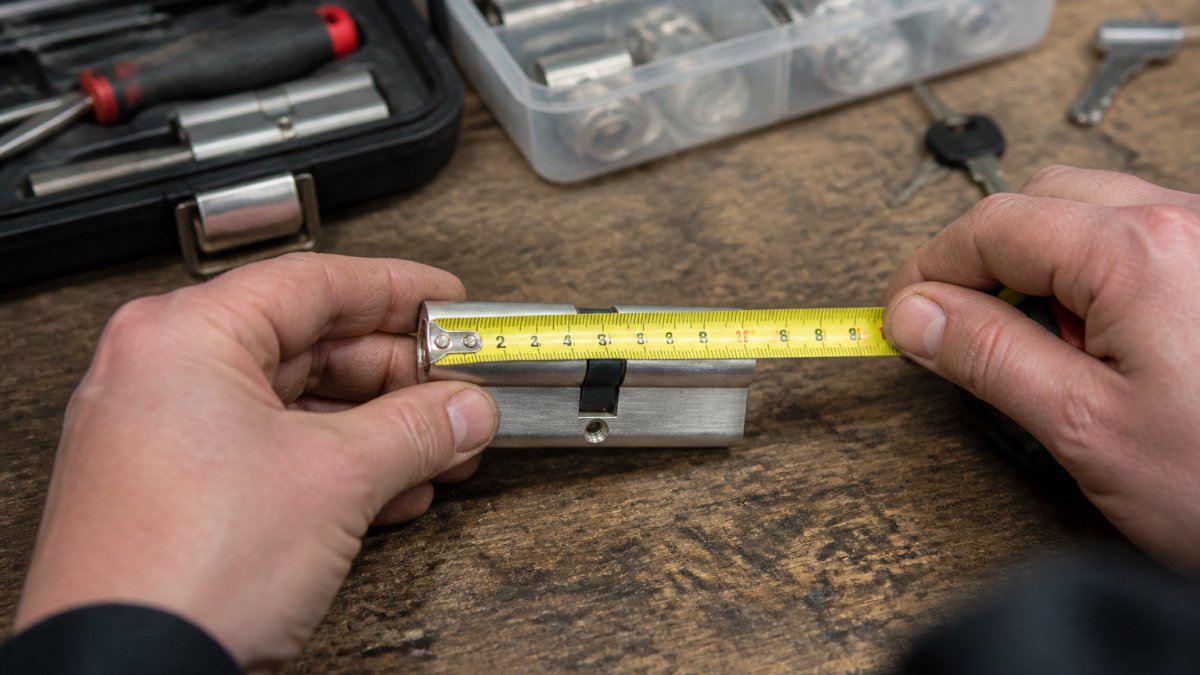
Here's the method:
- Remove the cylinder from the door first.
- Find the centre fixing hole in the middle of the cylinder.
- Measure from the centre hole to the outside face. Call this A.
- Measure from the centre hole to the inside face. Call this B.
- Your lock size is A-B, for example 45-50.
Centre Measurement, Offset and the Retaining Screw
The centre measurement is the distance from the middle of the fixing hole to the outer edge of the cylinder. The retaining screw is the long screw that holds the cylinder in place, and its position sets your offset.
If A and B are equal, the cylinder is centred. If they differ, the cylinder is offset, and you must order the same offset or the lock won't sit flush.
Write both numbers down before you shop. Getting them the wrong way round is the second most common mistake we see.
Step-by-Step: Removing the Old Lock
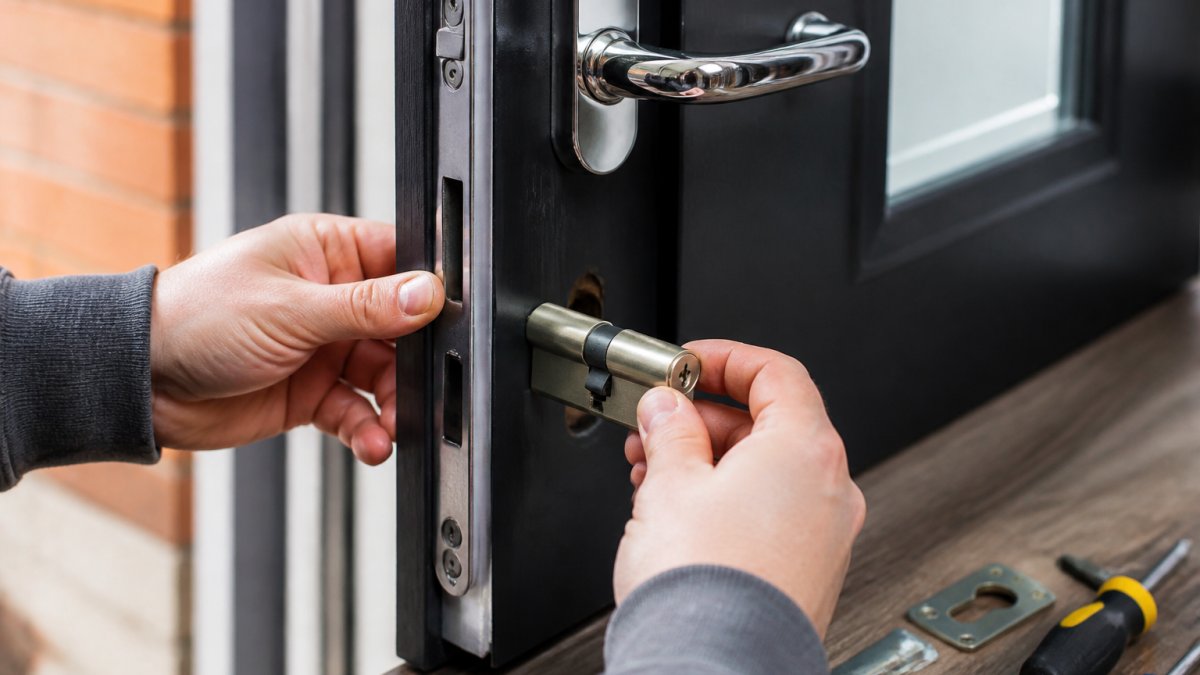
Removing the old lock takes about ten minutes on a euro cylinder. Open the door first so you can work from both sides.
- Open the door and locate the retaining screw on the door edge.
- Unscrew it fully and set it aside.
- Insert the key and turn it slightly to line up the cam.
- Push the cylinder out from one side while pulling from the other.
- If it sticks, check for a second screw or a grub screw under the handle.
For a mortice lock, unscrew the faceplate and the handle, then ease the lock case out of the door. For a night latch, remove the two screws holding the body to the door and lift it clear.
Fitting the Replacement Lock and Testing It
Fitting the replacement lock is the reverse of removal, but a few checks save you a second job. Slide the new cylinder in with the key turned slightly, then refit the retaining screw.
Next, test before you close the door:
- Turn the key both ways, fully
- Check the cam engages the lock case
- Confirm the cylinder sits flush with the door face
- Open and close the door three times
If the key turns stiffly, the cylinder is binding. Loosen the retaining screw a quarter turn and try again. If the door won't close, the cylinder is too long and the cam is catching the frame.
uPVC Door Lock Replacement: What's Different
uPVC door lock replacement follows the same steps as a euro cylinder swap, with one extra caution: the door edge is often reinforced with a metal strip, and the retaining screw can seize.
Spray a little lubricant on the screw and let it sit for a few minutes before you force it. Forcing a seized screw strips the head and turns a ten-minute job into a drill-out.
Also check the handle. A loose handle on a uPVC door is often the real cause of a stiff lock, not the cylinder. Tighten the handle screws first and retest.
Door Lock Replacement Cost: DIY vs Calling a Locksmith
Most guides either hide behind "call us for a quote" or pretend every job is a ten-minute DIY win. Neither helps you decide. Here is the honest trade-off, broken down by lock type.
What You Are Actually Paying For
Two costs sit behind any door lock change: the part and the labour.
- The part. The part cost varies significantly by lock type and security rating.
- The labour. Labour costs for a locksmith vary depending on the complexity of the job and the time of day.
Treat those as ballpark ranges, not quotes. Prices move with the lock, the door and where you are.
DIY vs Locksmith: A Job-by-Job Call
| Job | Realistic DIY time | DIY difficulty | When to call a locksmith |
|---|---|---|---|
| Euro cylinder swap | 20-40 minutes | Beginner | Seized retaining screw, or cylinder won't seat flush |
| Night latch replacement | 30-60 minutes | Beginner | Door has been forced and screw holes are stripped |
| Mortice lock replacement | 1-2 hours | Intermediate | Chisel work needed on a new mortice cut, or door is solid oak |
| Multipoint mechanism | 2-4 hours | Advanced | Almost always, gearbox alignment and door brand matching are fiddly |
| Lock after a break-in | Varies | Advanced | Always, the door frame is often damaged too |
The Hidden Costs of Getting It Wrong
A failed DIY attempt is rarely free. The common failure modes and what they cost you:
- Wrong-length cylinder. You eat the cost of the part and buy again. Measure twice.
- Stripped retaining screw. A drill-out and re-tap is a locksmith job, and you may need a new lock case.
- Damaged door edge. Chiselling a mortice pocket too deep or in the wrong place means filler, re-finishing, or a new door.
- Locked out mid-job. If you close the door with the cylinder half-fitted, you are paying an emergency call-out rate.
The Break-Even Point
For some lock types, DIY can be a cost-effective option, while for more complex mechanisms, professional assistance is often advisable.
If you are unsure which side of that line your job falls on, get the lock identified and measured first, that single step tells you whether it is a DIY job or a call-out.
For current prices and a clear quote, check N&G Locksmiths Service Ltd pricing page.
Security Standards, Insurance and Access Considerations
A replacement lock that fits the hole is not automatically a lock your insurer will accept. This section explains what the common markings mean, how to check them, and the access rules that matter when you are changing a lock on a rented or recently purchased property.
Reading the Markings on a Cylinder
When you look at a euro cylinder, you may see one or more of the following:
- BS EN 1303, the base European standard for cylinders. It grades cylinders on key security, durability, corrosion resistance and fire resistance. A cylinder can meet BS EN 1303 and still be a low-grade product, so the standard alone is not a security guarantee.
- TS 007, a UK technical specification for cylinders that resist snapping, bumping, picking and drilling. It is graded 1-star, 2-star or 3-star. A 1-star cylinder is intended to be paired with a 2-star handle or a security escutcheon to reach 3-star equivalent protection. A 3-star cylinder provides the full rating on its own.
- TS 008, the equivalent specification for handles and door furniture, so a 2-star handle paired with a 1-star cylinder can meet the 3-star requirement.
- Kitemark, the BSI certification mark. Its presence means the product has been independently tested against the relevant standard, not just self-declared.
- Sold Secure, a separate testing scheme often used for insurance-approved products. Ratings run Bronze, Silver, Gold and Diamond.
What Insurers Actually Ask For
Most home insurance policies do not specify a named standard in the policy wording. Instead, they require that exterior doors are fitted with a lock that meets "a recognised standard" or that the property is secured "to a reasonable standard". Some policies are more specific and require a 3-star cylinder or a Kitemark-rated lock on the final exit door.
Because wording varies, the only reliable check is to read your own policy schedule and any endorsements. If the wording is vague, ask the insurer in writing what standard they require before you buy. Keep the receipt and the packaging showing the rating, if you ever claim, that is your proof.
Access, Tenancy and Key Control
Security standards cover the hardware. Access rules cover the people.
- New occupiers. If you have just moved in, change the exterior locks on day one. You cannot know how many copies of the previous keys exist.
- Landlords. Keep a written record of who holds keys and when they were issued. Change or rekey the locks between tenancies, and record the change in the inventory.
- Tenants. Check your tenancy agreement before changing a lock. Many agreements require the landlord's consent, and some require you to provide a key or restore the original lock at the end of the tenancy.
- Shared buildings. If your front door opens onto a communal area, check the lease or freehold terms, some prohibit altering the door furniture or the lock without consent.
- Spare keys. Store a spare somewhere secure and off-site, not under a plant pot. If a key is lost, treat the lock as compromised and rekey or replace it.
Safe Exit During the Work
A lock change is a security job, but it is also a safety job. Before you start:
- Tell someone you are working on the door, especially if you live alone.
- Keep a second exit available, a back door or a window, in case the door closes with the cylinder half-fitted.
- Never leave the door on the latch while the cylinder is out. A gust of wind or a child can close it.
- If you are working on the only exit and you are not confident, book a locksmith rather than risk being locked in or out.
Troubleshooting: Jammed, Stiff and Misaligned Locks
A jammed lock is usually an alignment problem, not a broken lock. Fix the door before you replace the hardware.
| Problem | Likely Cause | Fix |
|---|---|---|
| Key turns stiffly | Dry or dirty cylinder | Lubricate with graphite, not oil |
| Door won't close | Cylinder too long or door dropped | Re-measure, adjust hinges |
| Lock jams when locked | Misaligned strike plate | File or move the strike plate |
| Handle loose, lock stiff | Worn handle springs | Tighten or replace the handle |
| Key won't go in | Bent key or blocked pins | Try spare key, then replace cylinder |
Door alignment is the root cause more often than the lock itself. If the door has dropped on its hinges, tightening the hinge screws fixes the lock without touching it.
If you've measured, fitted and tested, and the lock still misbehaves, that's the point to call a professional rather than force it.
Frequently Asked Questions
Can I change the locks on my door myself?
Yes, most standard euro cylinders and mortice locks can be changed by a confident DIYer with basic tools. The job usually takes 20 to 40 minutes once you have the correct replacement. The tricky parts are identifying the lock type and measuring accurately, especially the centre measurement on a euro cylinder. If your door has a multipoint lock, or the door itself is misaligned, a professional door lock change is safer because forcing a new mechanism can damage the door.
How much do locksmiths charge to change a door lock?
Door lock replacement cost depends on the lock type, the time of day, and whether the locksmith supplies the hardware. Emergency call-outs outside normal hours may cost more than a booked appointment. N&G Locksmiths Service Ltd does not charge a call-out fee and publishes its pricing on its website, so you can check the figure before booking. Always ask whether the quote includes the replacement lock itself.
How do I measure a door lock cylinder before replacing it?
Remove the cylinder first, then measure from the centre of the retaining screw hole to each end of the cylinder. This gives you two figures, for example 35mm on one side and 45mm on the other. The total is the overall length. Also note the cam shape and whether the cylinder is offset. Take the old cylinder to the shop or match the measurements exactly online, because a cylinder that is too long will protrude and one that is too short will not sit flush.
When should I call a locksmith to change a door lock?
Call a locksmith if the door has a multipoint lock, if the door is misaligned or swollen, if the existing lock is jammed or the key has snapped inside, or if you need the work done urgently after a break-in or a lost key. A professional door lock change is also worth it when your insurance requires a specific standard, such as a British Standard Kitemark, and you are unsure which product meets it. N&G Locksmiths Service Ltd offers a 12-month guarantee on its work.
A stiff, jammed or damaged lock is more than an annoyance; it's a security gap, and it rarely fixes itself. If you'd rather not risk a wrong-size cylinder or a stripped screw, our team at N&G Locksmiths Service Ltd can handle the whole job. We offer 24/7 emergency service, no call-out fee and a 30-minute response, backed by a 12-month guarantee on our workmanship. Get started with N&G Locksmiths Service Ltd and get your door secure again.