 blog
blog
Best Budget-Friendly Security Upgrades for Old Wooden Doors
Table of Contents
- Why Older Wooden Doors Need Targeted Security Upgrades
- 1. The Best Security Lock for a Wooden Front Door
- 2. How to Reinforce a Wooden Door Frame and Strike Plate
- 3. Door Security Hinge Bolts: A Cheap Fix for Weak Hinges
- 4. Signs Your Door Locks Need Replacing (and What to Do)
- 5. Smart Locks and Electronic Access on a Budget
- 6. Doorbell Cameras, Alarms, and Motion Sensors for Older Doors
- 7. Physical Barriers: Security Grilles and Window Locks
- 8. Prioritising Upgrades: A Budget-Friendly Plan for Your Wooden Door
- Conclusion: Making Your Old Wooden Door Secure Without Breaking the Bank
- Frequently Asked Questions
Last Updated: October 5, 2026
Why Older Wooden Doors Need Targeted Security Upgrades
Older timber doors are built from solid wood and traditional joinery, which makes them strong but prone to warping, shrinking and loose hardware over time, and that is exactly why wooden door security deserves attention. That ageing process creates gaps, weak frames and dated locks that modern burglars know how to exploit.
At N&G Locksmiths Service Ltd, we see the same pattern on call-outs across Norfolk, Suffolk and Cambridgeshire: the door itself is fine, but the hardware around it has quietly failed. The good news is that the best budget-friendly security upgrades for older wooden doors rarely involve a full replacement. Most improvements cost a fraction of a new door and take under an hour to fit.
The official crime statistics for England and Wales show that domestic burglary remains a persistent concern, and police forces consistently advise that reinforced doors and windows are among the most effective deterrents. Below, we break down eight upgrades in priority order, with realistic cost guidance and notes on which jobs you can tackle yourself.
1. The Best Security Lock for a Wooden Front Door
The best security lock for a wooden front door is a British Standard mortice deadlock, ideally paired with an existing night latch rather than replaced by it. A mortice lock sits inside a pocket cut into the door itself, so the bolt is anchored in solid timber rather than surface-mounted hardware.
Look for a kite-marked lock rated to BS 3621. That standard is recognised by insurers and is often required for contents cover above a certain value. Where the door is thin or the timber is soft, a surface-fitted deadlock can be a practical alternative, though it offers less resistance to a determined attack.
Mortice Locks vs. Night Latches for Timber Doors
- Mortice deadlock: Sits inside the door, deeper bolt, harder to force. Best for front doors.
- Night latch: Surface-mounted, convenient for quick exit, but the bolt is shorter and easier to slip. Best used as a secondary latch.
- Mortice sashlock: Combines a latch handle with a deadbolt in one unit. Good for older doors where cutting two pockets is impractical.
A common mistake is fitting a high-security lock into a rotten or split door edge. The lock will fail before the burglar does.
2. How to Reinforce a Wooden Door Frame and Strike Plate
Reinforcing a wooden door frame means transferring the force of any attack away from soft timber and into the structural wall behind it. The strike plate is the metal fitting on the frame that receives the lock bolt. On older doors, this is often a short plate held by two short screws that pull out under pressure.
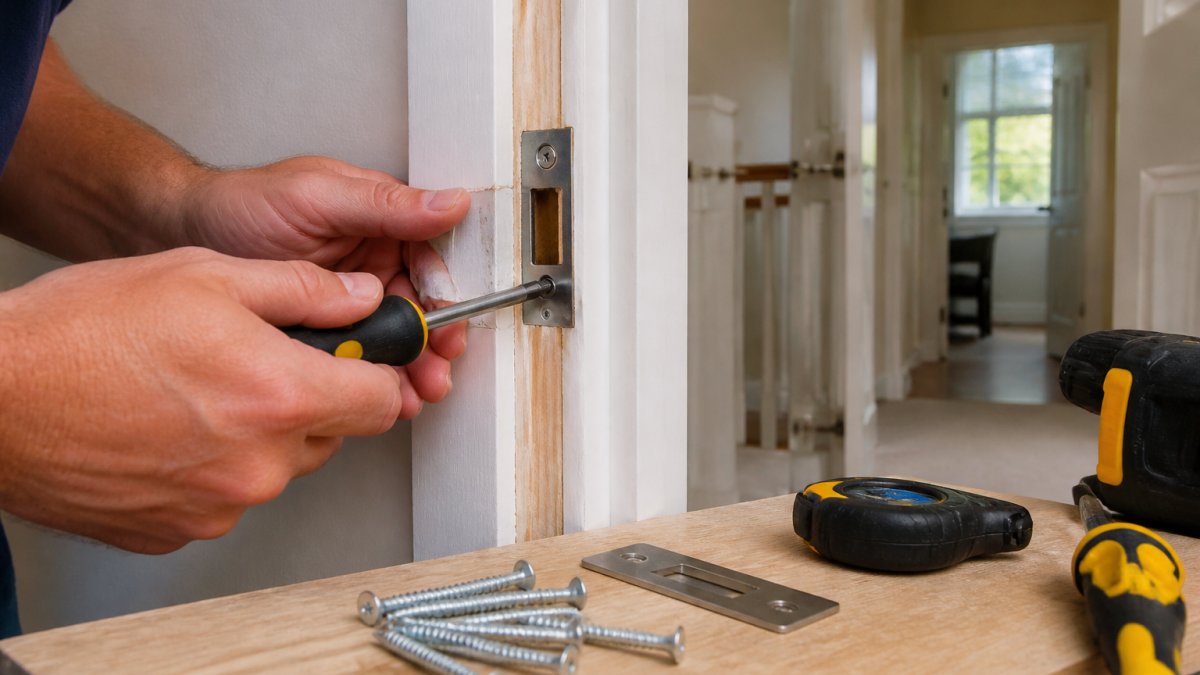
Upgrading to a longer, thicker strike plate and replacing the screws with 75mm or 100mm ones that reach into the wall stud makes a measurable difference. A metal plate spreads the load; longer screws stop the frame from splitting away.
Step-by-Step: Fitting Longer Screws and Metal Plates
- Remove the existing strike plate with a screwdriver.
- Check the timber behind for rot or splits. Treat or replace before continuing.
- Fit a reinforced strike plate, aligning it with the lock bolt.
- Drive 75mm screws through the plate into the wall behind the frame.
- Test the lock engages smoothly, then repeat on the hinge side if the frame is soft.
3. Door Security Hinge Bolts: A Cheap Fix for Weak Hinges
Door security hinge bolts are small metal pins fitted to the hinge side of the door that slot into the frame when the door closes. They stop the door being lifted off its hinges, which is one of the oldest tricks used on outward-opening timber doors.
They cost very little, take about ten minutes to fit per door, and are a simple win for wooden door security. On older wooden doors, hinge bolts are often the single most cost-effective upgrade available. A common mistake is fitting them to the wrong side of the door, so check the swing direction first.
4. Signs Your Door Locks Need Replacing (and What to Do)
Signs your door locks need replacing include a stiff or gritty key turn, a wobbly cylinder, visible wear on the bolt, keys that stick, and any lock that has been forced or tampered with. If the door has been kicked or the frame shows fresh damage, replace the lock rather than repair it.
Age matters too. A lock that has been in place for decades may meet no current standard and offer little resistance. If you have just moved in, changing the locks is standard practice, since you cannot know how many copies of the key exist.
- Key turns with resistance or grinding
- Lock body moves when you touch it
- Bolt does not fully extend
- Visible scratches or drill marks around the cylinder
- Keys lost or unaccounted for
5. Smart Locks and Electronic Access on a Budget
Smart locks and electronic access options now start at genuinely affordable levels, though the cheapest models trade durability for convenience. For an older wooden door, the key question is not which app looks best, it is whether the door thickness, the existing mortice cut-out and the frame condition will accept the unit at all.
Most retrofit smart deadlocks are designed to replace a night latch or a standard rim cylinder, not a deep mortice deadlock. If your door already has a BS 3621 mortice lock, a smart lock usually sits alongside it as a secondary latch rather than replacing it. That matters because removing a compliant mortice lock to fit a smart unit can leave you with a door that no longer meets the lock standard your contents policy expects.
Compatibility Checks Before You Buy
- Door thickness: Most retrofit smart deadlocks need roughly 35-45mm of door thickness at the fixing point. Older panelled doors are often thinner at the edge than the centre, so measure at the lock position, not the middle of the door.
- Existing cut-out: A smart deadlock that replaces a night latch needs the old cylinder hole filled or covered. A unit that replaces a mortice lock needs the pocket to match its body size, which is rarely a straight swap on a door fitted decades ago.
- Frame and strike: Every smart lock still throws a bolt into the same strike plate. If the frame is soft or the plate is held by two short screws, the electronics add convenience but no resistance.
- Handle and backset: Check the backset (the distance from the door edge to the centre of the spindle or cylinder) against the unit's specification. A mismatch means new drilling, which weakens an already-aged door edge.
What Budget Smart Locks Actually Cost
Expect to pay roughly £40-£90 for a basic keypad or app-controlled deadlock, £90-£180 for a mid-range model with a keypad and app, and £180 upwards for units with built-in alarms, auto-lock and audit trails. Fitting is usually straightforward on a door that already has a suitable cut-out, but a locksmith call-out to adapt an older door typically adds £60-£120 depending on the work involved.
Keypad entry, app control and temporary access codes for cleaners or carers are the features most owners actually use. What most guides miss is that a smart lock on a warped or split door edge will fail early, because the bolt alignment shifts as the timber moves with the seasons. If your door already sticks in damp weather, sort the frame and hinges first.
If you rent or manage multiple properties, electronic access removes the cost of rekeying after every tenant change. Ask us about compatibility before buying, since older doors vary widely and a unit that fits one Victorian front door may not fit the next.
6. Doorbell Cameras, Alarms, and Motion Sensors for Older Doors
Doorbell cameras, alarms and motion sensors add visibility and deterrence rather than physical resistance. A video doorbell mounted beside an older wooden door lets you see and speak to callers before opening, and footage is often useful to police after an incident.
Motion sensors placed on the approach to the door catch movement before anyone reaches the handle. A basic alarm with a door contact is inexpensive and pairs well with the physical upgrades above. None of these replace a good lock, but together they change how a burglar assesses the property.
7. Physical Barriers: Security Grilles and Window Locks
Security grilles and window locks matter because a reinforced front door simply pushes an intruder toward the nearest weak point. Ground-floor windows, side gates and rear doors are the usual targets.
Fitting key-operated window locks to ground-floor frames is cheap and quick. Security grilles suit basement or vulnerable windows but should never block a fire escape route. Check that any grille can be opened from inside without a key in an emergency.
- Window locks on all ground-floor openings
- Grilles on vulnerable or concealed windows
- Security film on large panes to hold glass together
- Locked side gates to remove easy access to the rear
8. Prioritising Upgrades: A Budget-Friendly Plan for Your Wooden Door
Prioritising upgrades means fixing the frame and strike plate first, then the lock, then hinges, then electronics. This order gives you the biggest security gain for the least money, because a strong lock in a weak frame fails first. Below is a staged plan with realistic cost ranges, so you can see what each pound buys and where DIY stops being sensible.
Stage 1: Quick Fixes Under £30
These are the jobs almost any householder can complete with a screwdriver in under an hour.
- Reinforced strike plate and 75-100mm screws: £8-£20 for the plate and screws. This is the single highest-value upgrade on an older timber door, because it stops the frame splitting away from the bolt.
- Hinge bolts: £10-£25 per pair. Ten minutes per door and they prevent the door being lifted off its hinges.
- Key-operated window locks: £8-£15 each. Ground-floor windows are usually the easiest entry point once the front door is reinforced.
- Door chain or limiter: £10-£20. Useful for answering the door without opening it fully.
Stage 2: Hardware Upgrades £30-£150
Once the frame is sound, the lock itself is worth attention.
- BS 3621 mortice deadlock: £30-£70 for the lock, plus £60-£120 for professional fitting if the door needs a new pocket cut. This is the standard insurers most often ask about for contents cover.
- Mortice sashlock: £40-£90. A good option where cutting two separate pockets is impractical on an older door.
- Surface-fitted deadlock: £20-£50. A practical fallback on thin or soft timber, though it offers less resistance than a mortice lock.
- Smart deadlock: £40-£180 depending on features. Best treated as a convenience upgrade layered on top of a compliant lock, not a replacement for it.
Stage 3: Professional Assessment £0-£150
If the frame is soft, the door is warped, or the existing cut-out does not match any standard lock body, that is where a professional survey saves money. A locksmith can tell you in minutes whether the door will accept a mortice lock, whether the frame needs a reinforcement kit anchored into the masonry, and whether the door is worth upgrading at all. Many firms, including ours, offer this assessment free of charge.
The Order That Actually Works
| Priority | Upgrade | Typical Cost | DIY Difficulty | Main Benefit |
|---|---|---|---|---|
| 1 | Longer screws and reinforced strike plate | £8-£20 | Easy | Stops frame splitting |
| 2 | Hinge bolts | £10-£25 | Easy | Prevents door removal |
| 3 | Window locks | £8-£15 each | Easy | Closes the easy entry point |
| 4 | BS 3621 mortice lock | £30-£70 plus fitting | Professional | Meets insurance standards |
| 5 | Smart lock or alarm | £40-£180 | Moderate | Convenience and deterrence |
When DIY Is Not Suitable
Cutting a mortice pocket into an older door is the point where most householders should stop. The timber may be split internally, the door may be thinner than it looks, and a misaligned cut weakens the very edge the lock depends on. The same applies to frame reinforcement kits that need anchoring into masonry, and to any door that has already been forced. In those cases, the cost of a professional fit is usually less than the cost of a replacement door.
Conclusion: Making Your Old Wooden Door Secure Without Breaking the Bank
Older wooden doors can be brought up to a genuinely secure standard without replacement, provided you fix the frame before the hardware. Work through the priorities above, and you will spend far less than a new door would cost.
If any part of the job involves cutting a mortice, replacing a failed lock or reinforcing a soft frame, that is where a professional assessment saves money and avoids damage. N&G Locksmiths Service Ltd offers a no call-out fee, a 30-minute response time and a 12-month guarantee on all work. Call now to book your survey and secure your wooden door properly.
Frequently Asked Questions
What are the best budget-friendly security upgrades for older wooden doors?
Start by upgrading to a British Standard mortice lock or night latch, then reinforce the strike plate with 75mm screws and add hinge bolts. These changes cost little but significantly improve wooden door security. A doorbell camera or motion sensor light adds another layer without major expense. Always check that upgrades suit your door's condition and material.
How can I secure the hinges on an older wooden door?
Fit door security hinge bolts on the hinge side of the door. These metal bolts slot into the frame when the door closes, preventing it from being prised open even if hinges are removed. They are inexpensive, easy to install, and work well on timber doors. For best results, combine with a reinforced strike plate and a quality lock.
Should I replace the lock or reinforce the door frame first?
Reinforce the door frame first if it is weak or damaged, as a strong lock is useless on a flimsy frame. Fit longer screws into the strike plate and consider a metal reinforcement plate. Once the frame is secure, upgrade to a British Standard lock. This order ensures your wooden door security is not compromised by structural weaknesses.
When should an old wooden door be replaced rather than upgraded?
If the door is warped, has significant rot, or the frame is crumbling, replacement may be more cost-effective than repeated repairs. However, many older wooden doors can be secured affordably with reinforcement plates, hinge bolts, and a quality lock. A professional security assessment can advise whether upgrades will provide sufficient protection or if replacement is necessary.