 ultimate-guide
uPVC Door Mechanism Repair Cost Guide (2026 UK)
Table of Contents
- uPVC Door Mechanism Repair Cost: What You'll Pay in 2026
- How to Tell if uPVC Door Mechanism is Broken
- uPVC Door Gearbox Replacement Cost Breakdown
- Locksmith Call-Out Fee: What Counts as Standard?
- Multipoint Locking System Repairs and Security Ratings
- Factors That Influence the Final Repair Bill
- Insurance Compliance and BS3621 Standards
- Maintenance Tips to Prevent Mechanism Failure
- Conclusion: Repair or Replace?
- Frequently Asked Questions
Last Updated: September 7, 2026
uPVC Door Mechanism Repair Cost: What You'll Pay in 2026
A broken uPVC door mechanism is one of the most common and frustrating household failures, leaving you unable to lock your door securely or, worse, locked out entirely. This guide breaks down the uPVC door mechanism repair cost landscape for 2026, covering everything from gearbox replacements to multipoint locking system overhauls. The truth is that the final bill depends far less on the cost of parts and far more on accurate diagnosis of the actual fault, which is where many homeowners get caught out.
Most people assume a stiff handle or a door that won't latch means a full mechanism replacement. In practice, many failures trace back to a single worn component, such as a broken spring or a snapped gearbox cam, which costs significantly less to address. Understanding what you are paying for is the first step to avoiding an inflated invoice.
Below, we'll show you how to identify mechanical faults, what each repair typically costs in labour and parts, and how to ensure you are getting a fair price. We'll also cover the security implications of your repair choice, because replacing a failed mechanism is the perfect moment to upgrade your door's overall protection.
How to Tell if uPVC Door Mechanism is Broken
The most reliable way to tell if a uPVC door mechanism is broken is to observe how the failure presents itself. A mechanism that has failed internally will typically show one of three symptoms: the handle feels stiff or spongy and drops back down on its own, the key turns freely but the locking points do not engage, or the door sags and the keep plates no longer align with the hooks and rollers. Each symptom points to a different internal component, which directly influences the repair cost.
A handle that springs back to horizontal on its own almost always indicates a broken spring inside the gearbox. This is a common failure point because the spring is under constant tension every time you lift the handle to lock the door. A key that turns but does nothing suggests the cam or the locking strip inside the mechanism has sheared off. A door that scrapes the frame or requires a shoulder to close usually means the door sash has dropped on its hinges, throwing the entire mechanism out of alignment.
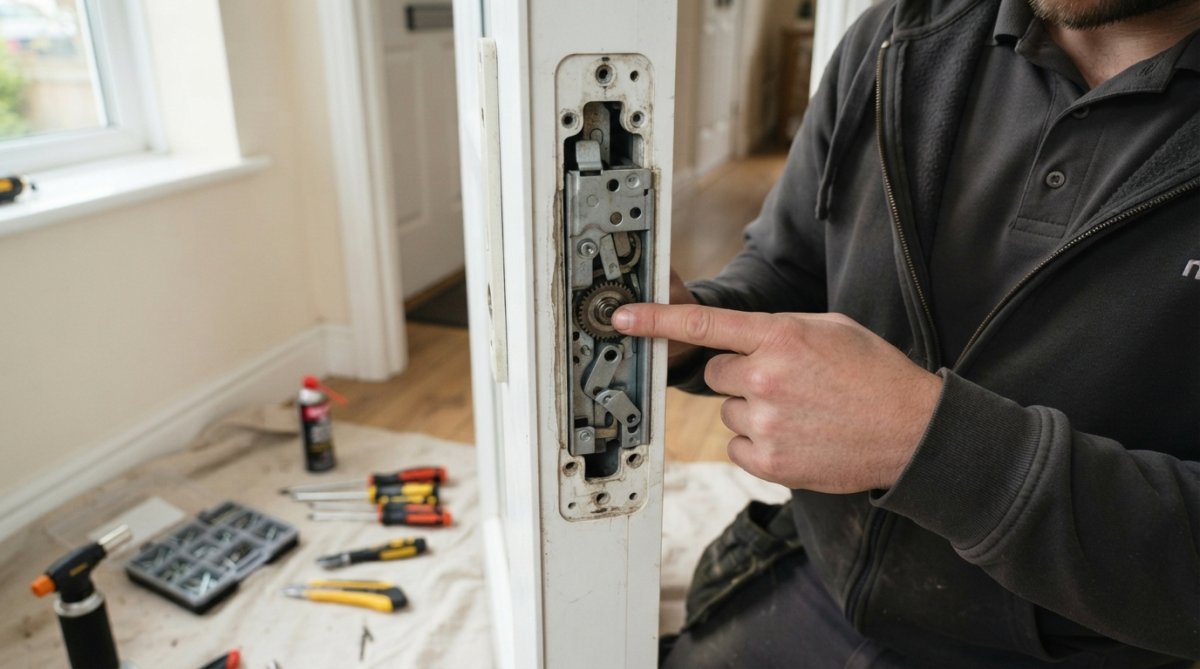
The Visual Diagnostic Guide
Use this quick reference to match your symptom to the likely fault before you pick up the phone. This is the diagnostic-first approach that most price guides skip, yet it is the single biggest factor in controlling your final bill.
| Symptom You Notice | Likely Fault | Typical Repair Scope |
|---|---|---|
| Handle drops back to horizontal | Broken gearbox spring | Gearbox replacement |
| Key turns, locking points don't move | Sheared cam or locking strip | Gearbox or strip replacement |
| Door won't latch without slamming | Dropped door sash or worn keep | Hinge adjustment or keep realignment |
| Key won't insert or won't turn | Worn Euro cylinder or debris | Cylinder replacement |
| Handle stiff to lift | Dried mechanism or misalignment | Lubrication or gearbox replacement |
uPVC Door Gearbox Replacement Cost Breakdown
The gearbox is the heart of the uPVC door mechanism, and its replacement is the most common repair we see. The uPVC door gearbox replacement cost is typically the largest single line item on an invoice because it is the component that converts the handle's rotation into the movement of the locking points. It sits inside the door profile and must be matched precisely to the brand and backset of your door.
What You're Paying For
Your invoice will typically break down into three parts: the part itself, labour, and call-out (if applicable). Here's a realistic breakdown based on current UK trade rates for 2026:
| Component | Typical Cost (Parts Only) | Notes |
|---|---|---|
| Standard gearbox (universal pattern) | £25-£50 | Fits many common brands but may require slight modification. |
| Genuine manufacturer gearbox (e.g., Yale, ERA, Mila) | £50-£90 | Exact match for your door brand; better guarantee of fit. |
| Premium gearbox with anti-snap cylinder | £90-£140 | Often bundled with a 3-star cylinder for security upgrade. |
| Labour (professional fitting) | £80-£150 | Includes removal of door panels, extraction, fitting, and testing. |
| Call-out fee (if not waived) | £40-£80 | Many local locksmiths absorb this into the labour cost. |
Total typical cost range: £120-£250 for a standard gearbox replacement, with most homeowners paying between £150 and £200. If you need an emergency call-out outside working hours, expect the total to rise by 50-100%.
Why the Part Price Varies So Much
The gearbox is a manufacturer-specific component. A genuine replacement for a well-known brand like Yale or ERA will cost more than a universal pattern part because it is engineered to the exact tolerances of your door. Universal parts are cheaper but may require filing down or shimming to fit, which adds labour time and can void the guarantee if not fitted perfectly. A common pattern is that a universal part costs less but may add extra fitting time, potentially wiping out the saving.
Labour: What a Professional Actually Does
A competent fitter will not simply swap the gearbox. The process involves:
- Removing the door panels (usually held by screws behind the handle and lock).
- Extracting the old gearbox carefully to avoid damaging the door profile.
- Matching the new gearbox to the old one, checking the backset (distance from the handle spindle to the edge of the door), the length, and the position of the locking points.
- Fitting the new gearbox and reassembling the door.
- Testing the handle lift, key turn, and all locking points to ensure smooth operation.
- Checking the alignment of the keep plates and adjusting if necessary.
This is why labour costs are higher than a simple 'swap' job. If the door has dropped or the keeps are misaligned, additional adjustment work will add to the bill.
The Pitfall of Buying Your Own Gearbox
A common mistake is to buy a cheap universal gearbox online and expect a locksmith to fit it for a reduced labour fee. Most reputable tradespeople will not guarantee a part they have not supplied, because the fit and finish of pattern parts can vary. If the part fails, you'll pay for another call-out and another labour charge. Paying marginally more for a matched component fitted by a professional who guarantees the work is often the better value.
How to Get an Accurate Quote
Before you call, measure the backset of your door (the distance from the handle spindle to the edge of the door) and note the brand name if visible. This information allows a locksmith to quote a fixed price over the phone without a site visit. If you can't find the brand, a reputable locksmith will carry a range of common gearboxes and can match it on site, but expect a slightly higher quote to cover the risk of carrying more stock.
Locksmith Call-Out Fee: What Counts as Standard?
A locksmith call-out fee is the charge for the tradesperson to travel to your property and is separate from the cost of any repair work carried out. This is the area where pricing transparency matters most, and it is also where many homeowners have been burned by hidden charges. A legitimate locksmith will quote the call-out fee clearly when you phone, before any work begins.
Some companies advertise a "no call-out fee" model, which can be attractive. In this model, the cost of travel is absorbed into the repair price. As a family-run business operating across Norfolk, Suffolk, and Cambridgeshire, N&G Locksmiths Service Ltd uses this approach because it removes the surprise of an upfront charge and lets customers compare the total cost of the job rather than a headline fee.
Multipoint Locking System Repairs and Security Ratings
A multipoint locking system is the network of hooks, rollers, and keep plates that secure your door at multiple points along the frame when you lift the handle and turn the key. When this system fails, the door is often only held by the central latch, which is a serious security weakness. Repairing a multipoint locking system can involve replacing the gearbox, the locking strip, the keep plates, or simply realigning the door.
Common Failure Points and What They Cost
Multipoint systems fail in predictable ways. Here's a symptom-to-part guide that goes beyond the basics:
| Symptom | Likely Fault | Typical Repair Cost (Parts + Labour) |
|---|---|---|
| Handle lifts but hooks don't engage | Gearbox failure or broken locking strip | £150-£250 |
| Door locks but only the central bolt throws | Sheared cam or gearbox spindle | £150-£250 |
| Hooks scrape the keep plates | Door sag or misaligned keeps | £60-£120 (adjustment) |
| Key turns but won't unlock | Euro cylinder worn or broken | £80-£150 (including cylinder) |
| Door rattles in the frame | Worn keep plates or rubber seals | £40-£80 (replacement) |
The Repair Process: What a Professional Does
A multipoint repair is not just a parts swap. A thorough locksmith will:
- Diagnose the exact failure by testing the handle, key, and locking points.
- Remove the door panels to access the mechanism.
- Inspect the gearbox, locking strip, and keep plates for wear or damage.
- Replace the failed component, often the gearbox or locking strip.
- Re-align the keep plates if the door has dropped, using shims or adjusting the hinge side.
- Test all locking points to ensure they engage and release smoothly.
If the door has dropped, a simple gearbox replacement won't fix the problem. The locksmith must also adjust the hinges or add packing to the keep plates, which adds to the labour.
Security Ratings: What Actually Matters
This is where the security rating of your hardware becomes relevant. The British Standard for locks is BS3621, which applies to mortice deadlocks and certain cylinder locks. While BS3621 is a well-known benchmark, many modern uPVC door mechanisms are tested to the more demanding Secured by Design standards, a police-preferred specification that assesses the whole door assembly rather than just the lock. When your mechanism fails, upgrading to hardware that meets these higher standards is often a modest additional cost.
The Upgrade Opportunity: Anti-Snap Cylinders and Handles
The door handle spring and the cylinder are the two upgrade points that offer the best security value during a repair. Replacing a standard Euro cylinder with an anti-snap lock, which is designed to break in a controlled way under attack, is a relatively small additional expense compared to the labour already being charged. A 3-star anti-snap cylinder typically costs more than a standard cylinder, but it can prevent a burglary.
Similarly, ensuring your door furniture is fitted with the correct screws and backplates prevents attackers from simply snapping the handle off. Many uPVC doors are fitted with handles that use short screws into the door panel, which can be ripped off with a crowbar. Upgrading to a handle with a full backplate and security screws (often called 'anti-snap' or 'anti-drill') adds to the repair but significantly improves resistance.
Insurance Compliance: The Hidden Risk
Home insurance policies often require that any replacement lock fitted to an external door meets minimum security standards, and this is where BS3621 comes into play. The BS3621 standard for thief-resistant locks specifies the requirements for mortice locks and certain cylinder locks used on external doors. If your policy specifies a BS3621-compliant lock, fitting anything less could invalidate your claim in the event of a burglary.
It is worth checking your policy wording before you agree to a repair. Many modern multipoint locking systems are not BS3621 certified because they are tested to a different standard that covers the entire door assembly, such as PAS 24. Insurers generally accept these higher whole-door standards, but it is your responsibility to confirm what your specific policy requires. A reputable locksmith should be able to advise on whether the proposed replacement meets common insurance requirements.
The Unique Angle: Visual Inspection Checklist
Before you call a locksmith, you can do a simple visual inspection that will save time and money:
- Look at the keep plates: Are they worn or bent? If the hooks are scraping, you'll see fresh metal marks.
- Check the door alignment: Close the door and look at the gap between the door and the frame. If it's wider at the top than the bottom, the door has dropped.
- Test the handle: If it feels spongy or drops back, the spring is likely broken.
- Inspect the cylinder: If the key is hard to insert or turn, the cylinder may be worn or the mechanism inside is jammed.
This checklist helps you describe the fault accurately to a locksmith, which means they can bring the right parts and give you a more accurate quote over the phone.
Factors That Influence the Final Repair Bill
Several factors push the uPVC door mechanism repair cost up or down, and understanding them helps you sanity-check any quote you receive. The first is the brand and age of your door. Obscure or discontinued door brands require more time to source matching parts, which increases both the labour time and the part cost. The second is the extent of the damage; a snapped gearbox is a straightforward swap, while a damaged door sash or frame requires more involved work.
The time of day and day of the week also matter. An emergency locksmith call-out outside of normal working hours, at night, or on a bank holiday will command a premium. This is standard practice across the trade, reflecting the genuine cost of providing 24/7 availability. The third factor is regional variation in labour charges. Prices in and around major cities tend to run higher than in rural areas, reflecting higher overheads.
| Cost Factor | How It Affects Price | What You Can Do |
|---|---|---|
| Door brand and age | Obscure brands cost more to source parts for | Have the door brand name ready when you call |
| Time of call | Night and weekend call-outs cost more | Book a daytime repair where possible |
| Part quality | Genuine parts cost more than universal patterns | Balance guarantee against upfront saving |
| Door alignment | Misaligned doors need extra adjustment work | Check and adjust keeps before calling |
Insurance Compliance and BS3621 Standards
Home insurance policies often require that any replacement lock fitted to an external door meets minimum security standards, and this is where BS3621 comes into play. The BS3621 standard for thief-resistant locks specifies the requirements for mortice locks and certain cylinder locks used on external doors. If your policy specifies a BS3621-compliant lock, fitting anything less could invalidate your claim in the event of a burglary.
It is worth checking your policy wording before you agree to a repair. Many modern multipoint locking systems are not BS3621 certified because they are tested to a different standard that covers the entire door assembly, such as PAS 24. Insurers generally accept these higher whole-door standards, but it is your responsibility to confirm what your specific policy requires. A reputable locksmith should be able to advise on whether the proposed replacement meets common insurance requirements.
Maintenance Tips to Prevent Mechanism Failure
Most uPVC door mechanism failures are preventable with basic maintenance that takes minutes per year. The most common cause of gearbox failure is a lack of lubrication, which makes the mechanism stiff, puts strain on the internal springs, and eventually causes them to snap. Lubricating the moving parts of the locking mechanism and the hinges twice a year is the single most effective way to extend its life.
The second most common cause is misalignment caused by a dropped door. Over time, the weight of the door causes the hinges to wear and the sash to drop, so the locking points no longer line up with the keep plates. This forces the mechanism to work harder and can cause the gearbox to fail. Checking that the door is level and adjusting the hinges when you notice a drop prevents this strain.
- Lubricate the gearbox and locking points with a dry PTFE spray twice a year, not oil which attracts dust.
- Check the door is level by closing it and looking at the gap between the door and the frame.
- Tighten any loose handle screws, as a wobbly handle puts uneven stress on the gearbox spindle.
- Clean the keep plates and locking points to remove dirt that prevents smooth engagement.
Conclusion: Repair or Replace?
The decision to repair or replace a uPVC door mechanism comes down to the age of the door and the extent of the failure. A straightforward gearbox or cylinder replacement on a door under fifteen years old is almost always worth doing. If the door is older, the frame is damaged, or the mechanism has failed multiple times, replacing the whole door may be the better long-term investment.
What matters most is accurate diagnosis before you commit to any work. A professional who identifies the specific failed component and explains your options, including the security upgrade path, is valuable. Avoid the temptation to choose the cheapest quote without understanding what it includes.
When your uPVC door mechanism fails, whether it is a snapped gearbox or a jammed multipoint locking system, you need a repair you can trust. N&G Locksmiths Service Ltd offers 24/7 emergency response across Norfolk, Suffolk, and Cambridgeshire, with no call-out fee, a 30-minute response time, and a genuine 12-month guarantee on all workmanship. Our certified professionals will diagnose the fault, explain the repair cost clearly, and ensure your door meets the security standards your insurance requires. Call now for a fast, upfront quote and complete peace of mind.
Frequently Asked Questions
How much does it cost to replace a uPVC door mechanism?
The final price depends on the mechanism type, the extent of the fault, and your location. A full multi-point locking system replacement costs more than a simple gearbox swap. Labour charges and any call-out fee also factor into the total. Get a fixed quote before work begins so you know exactly what you are paying for. A reputable locksmith will inspect the door and provide a clear price for parts and labour before starting.
How much does a uPVC door gearbox replacement cost?
A gearbox replacement is one of the most common uPVC door repairs. The cost varies based on the brand of the door and the specific gearbox model required. You pay for the replacement part plus the locksmith's labour. Ask for a price that includes VAT and the fitting. A professional will confirm the exact gearbox needed by examining the existing mechanism or its measurements, ensuring a correct match first time.
How can I tell if my uPVC door mechanism is broken?
Common warning signs include a handle that feels stiff, drops down, or spins freely without engaging the lock. You might also struggle to lift the handle to lock the door, or hear grinding noises when turning the key. If the door sags and the locking points no longer align with the keep, the mechanism is likely failing. Address these issues promptly to avoid being locked out or facing a more expensive repair.
Are locksmith call-out fees standard for door repairs?
Call-out fees are common in the locksmith industry, but they are not universal. Some companies, like N&G Locksmiths Service Ltd, do not charge a call-out fee at all. When a fee applies, it typically covers the tradesperson's travel time and the initial diagnostic visit. Always confirm whether the call-out fee is waivable against the repair cost and ask for the total quote before any work is carried out.
Will my home insurance require a specific lock standard after a repair?
Many UK home insurance policies specify that external doors must have locks meeting the BS3621 standard. If you are making an insurance claim, check your policy documents first. A qualified locksmith can advise whether your replacement mechanism meets the required security rating. Choosing an anti-snap Euro cylinder that complies with the standard helps keep your cover valid and improves your home's security.