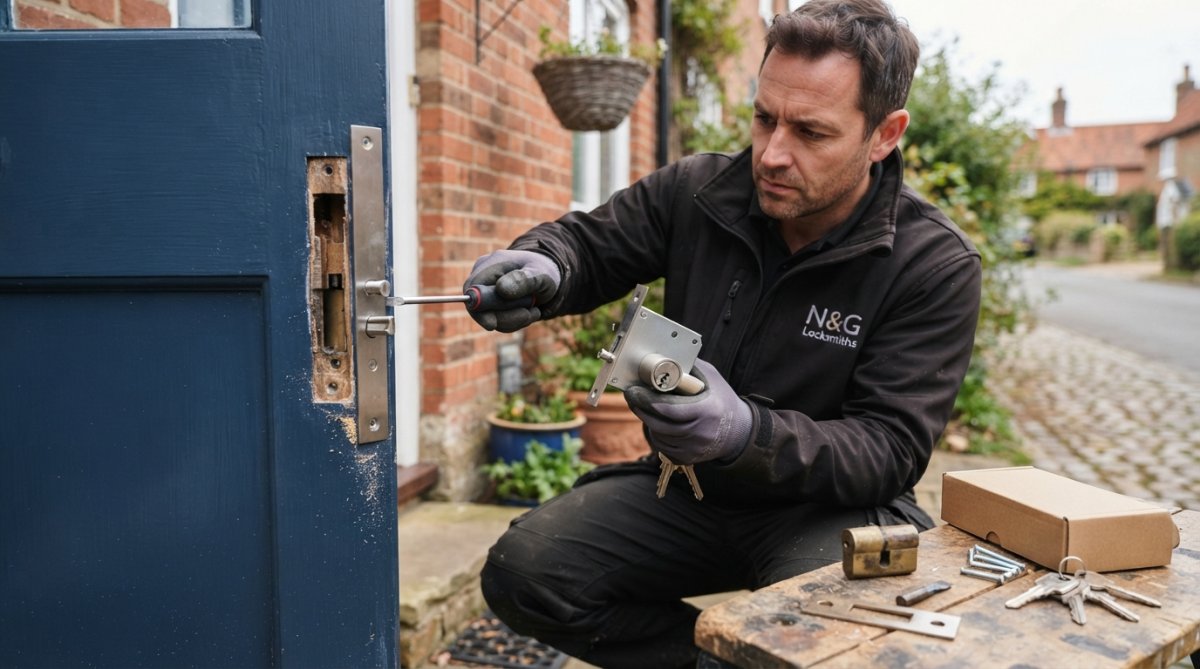
 ultimate-guide
Why Lock Changes Are Necessary: A 2026 Home Security Guide
Table of Contents
- Why Lock Changes Are Necessary: An Overview
- Moving into a New Home: The First Lock Change
- Lost or Stolen Keys: When to Act Fast
- After a Break-In or Burglary: Restoring Security
- Signs Your Door Locks Need Replacing: Wear and Tear
- Upgrading to High-Security Standards: BS3621 Lock Standards Explained
- Rekeying vs. Replacing Locks: What's Right for You?
- Relationship Breakdown or Roommate Changes: Regaining Control
- How Much Does It Cost to Change Locks on a House?
- Conclusion: Securing Your Peace of Mind
- Frequently Asked Questions
Last Updated: September 14, 2026
Why Lock Changes Are Necessary: An Overview
Lock changes are necessary whenever the security of a property has been compromised, when a lock has worn beyond reliable function, or when insurance and building standards demand certified hardware. At N&G Locksmiths Service Ltd, we see the same pattern across residential and commercial call-outs: most people delay a lock change until something goes wrong. That delay is the real risk. A lock that has protected a home for years can become the weakest point in the property within weeks if keys go missing or the mechanism degrades.
Below, we break down every scenario that warrants a lock change, from moving house to recovering after a burglary, and explain how BS3621 standards and insurance requirements shape the decision.
Moving into a New Home: The First Lock Change
The first lock change should happen on day one of a new tenancy or purchase. You have no record of who holds copies of the previous keys, and no way to verify how many were cut. A common mistake is assuming the estate agent collected every set. In practice, spare keys routinely end up with cleaners, contractors, neighbours, or former occupants.
Replacing the cylinders on all external doors gives you a clean slate. If the existing locks are in good condition, rekeying is often the faster and cheaper route because it changes the internal pins rather than the entire mechanism. Either way, the goal is the same: only you hold a working key.
- Change or rekey every external door, including back doors and garage side entrances
- Check that window locks and patio door mechanisms are also secure
- Keep a record of the locks fitted, including make and standard, for future insurance claims
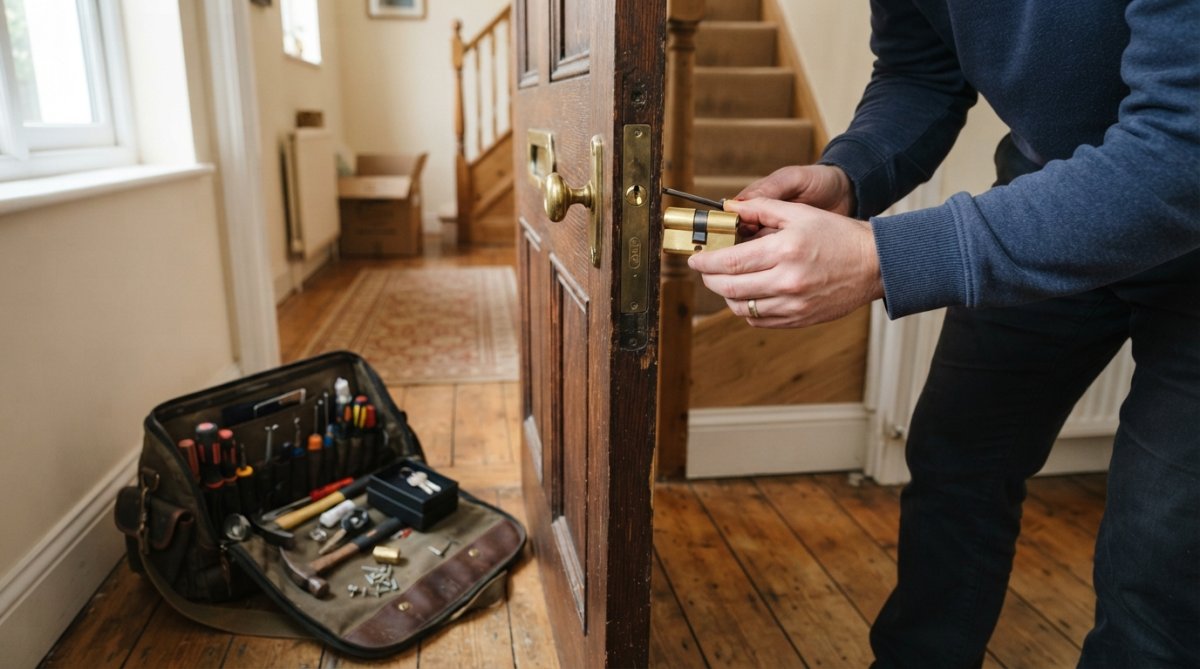
Lost or Stolen Keys: When to Act Fast
A lost or stolen key is an emergency, not an inconvenience. If the key was taken with a wallet or bag containing your address, the risk of opportunistic theft rises sharply. Act the same day.
A lock change or rekey is the only way to guarantee the missing key no longer opens your door. Changing the lock removes the old key from circulation entirely. Rekeying achieves the same result at lower cost when the lock body itself is sound. For vehicles, key duplication and programming require a certified locksmith with the right diagnostic equipment, because modern transponder keys cannot simply be cut at a hardware shop.
After a Break-In or Burglary: Restoring Security
After a break-in, restoring physical security is as urgent as the police report. Burglars frequently return to the same property, and a damaged or forced lock is an open invitation. A vulnerability assessment should cover every entry point, not just the door that was attacked.
Forced entry often damages the cylinder, the strike plate, or the door frame itself. Replacing only the visible lock and ignoring a bent frame leaves the door weak. A proper repair addresses the full lock mechanism and the surrounding door hardware.
- Replace any cylinder that shows signs of drilling, snapping, or forcing
- Reinforce strike plates and consider anti-snap locks on exposed doors
- Review lighting and sightlines around entry points as part of burglary prevention
EXTERNAL_LINK: Metropolitan Police [home security guidance | met.police.uk]
Signs Your Door Locks Need Replacing: Wear and Tear
Signs your door locks need replacing include a stiff or gritty key action, a key that must be jiggled to turn, visible scratches around the cylinder, and a lock that no longer engages smoothly. Mechanical failure rarely happens overnight. It develops gradually as internal pins and springs wear down.
A lock under this kind of wear and tear can fail completely at the worst possible moment, leaving you locked out or, worse, unable to secure the door. If a key has become difficult to remove, or the door needs to be pushed and pulled to lock, the mechanism is telling you it is near the end of its service life.
A simple maintenance schedule prevents most of this. Regular maintenance, such as lubricating the lock mechanism, can extend its lifespan and avoid an emergency call-out later.
| Warning Sign | What It Means | Recommended Action |
|---|---|---|
| Key sticks or jams | Worn internal pins | Rekey or replace cylinder |
| Visible cylinder scratches | Attempted forced entry | Fit anti-snap lock |
| Loose screws or strike plate | Door hardware failing | Reinforce or replace hardware |
| Key turns but door won't lock | Misaligned mechanism | Full lock service or replacement |
Upgrading to High-Security Standards: BS3621 Lock Standards Explained
BS3621 is the British Standard for thief-resistant locks, and it is the benchmark insurers look for on external doors. A lock carrying the BS3621 kitemark has been tested against drilling, picking, chiselling, and physical attack, so it offers far more resistance than a basic cylinder. Understanding BS3621 lock standards explained simply: it is the difference between a lock that meets a minimum requirement and one engineered to resist a determined intruder.
What BS3621 Actually Tests
The standard covers five key attack methods: drilling through the cylinder or body, picking and manipulation of the mechanism, forcing the bolt with tools, cutting or sawing the bolt, and attack on the lock furniture. A lock must resist each of these for a set period to pass. That is why a BS3621 lock is heavier, uses hardened steel components, and often includes a sacrificial cylinder designed to snap cleanly without exposing the mechanism.
It is worth knowing how BS3621 sits alongside other ratings you may see quoted:
- BS3621, the long-standing British Standard for thief-resistant locks on timber and composite doors. Most home insurers recognise it.
- TS007, a newer kitemark scheme for cylinders and door hardware, rated from one to three stars. A three-star cylinder meets the highest attack-resistance level and is often accepted by insurers in place of, or alongside, BS3621.
- Sold Secure, an independent testing scheme often referenced for padlocks, garage doors, and outbuildings rather than front doors.
Meeting one of these standards often lowers home insurance premiums and is a common condition in policy documents. If your current locks predate the standard or lack the kitemark, upgrading is one of the most cost-effective security improvements available.
The Smart Lock Question
Smart locks and keyless entry systems are increasingly popular, but they sit outside the traditional BS3621 framework. A smart lock may be convenient, yet its security depends on firmware updates, app security, and the reliability of its wireless protocol, none of which BS3621 was written to assess. A common pattern is for homeowners to fit a smart lock on the front door and leave a mechanical BS3621 lock on the back door as the insurer-recognised point of security.
If you are considering a smart lock, check three things before buying: whether the manufacturer commits to regular firmware and security updates, whether the lock has a mechanical key override in case the battery or app fails, and whether your insurer accepts it as a compliant lock on an external door. Some policies do, some do not, and some require a BS3621 or TS007 mechanical lock to remain fitted alongside it.
Upgrading Without Overpaying
You do not need to replace every lock in the property at once. The priority order most locksmiths follow is: the front door first, then any door reachable from the street or a side alley, then back doors and outbuildings. Anti-snap cylinders are particularly worthwhile on uPVC doors, where the cylinder is the most exposed component. If your existing lock body is sound, a cylinder upgrade to a TS007 three-star or BS3621-rated unit is often the cheapest route to meeting an insurer's requirement.
Rekeying vs. Replacing Locks: What's Right for You?
Rekeying is the better choice when the lock body is in good condition and you simply need to change who holds a working key. Replacing the lock is necessary when the mechanism is damaged, worn, or fails to meet security standards. The distinction matters because it affects both cost and security outcome.
Rekeying changes the internal pins so old keys no longer work, while keeping the same external hardware. It is faster and usually cheaper. Replacement swaps the entire lock, which is the right call after forced entry, when upgrading to anti-snap or BS3621 hardware, or when the existing lock is simply past its service life.
- Choose rekeying: new tenants, lost keys, relationship changes, sound lock body
- Choose replacement: burglary damage, worn mechanism, security upgrade, insurance requirement
Locksmiths and home security advice from Which?
Relationship Breakdown or Roommate Changes: Regaining Control
When a relationship ends or a housemate moves out, key control becomes a personal safety issue. A former partner or tenant may still hold a key, and asking for it back does not guarantee every copy is returned. Changing the lock removes any doubt.
This is one of the most common reasons for a lock change that people put off for emotional reasons. From a security standpoint, it should be treated like any other compromised key. A master key system, where one key opens several locks, can simplify management for landlords and property managers handling multiple properties. For a single home, a straightforward cylinder change restores control.
Citizens Advice on rented housing and security
How Much Does It Cost to Change Locks on a House?
How much it costs to change locks on a house depends on the type of lock, the number of doors, and whether you need rekeying or full replacement. Rather than quote a single misleading figure, it helps to understand what actually drives the price, and what a cheap quote may be hiding.
A standard cylinder change on a single uPVC or timber door is the simplest job and sits at the lower end of the range. A BS3621 or anti-snap upgrade costs more because the hardware itself is certified and tested. A full lock replacement after forced entry costs more again, because the strike plate, frame, or door furniture often needs work alongside the lock body.
What drives the price up or down:
- Standard cylinder change versus BS3621 or anti-snap upgrade
- Number of external doors, plus garage, side gate, and outbuilding locks
- Whether the job is a rekey (pins changed, existing hardware kept) or a full replacement
- Emergency or out-of-hours timing, including weekends and bank holidays
- Additional work such as strike plate reinforcement, frame repair, or door alignment
- Access, a door that is swollen, painted shut, or fitted with a multi-point mechanism takes longer
The DIY Trap: Why a Cheap Job Can Cost More Later
A common pattern among homeowners is to buy a cylinder online and fit it themselves to save on labour. The hardware may be fine, but two problems recur. First, an incorrectly sized cylinder, too long, too short, or protruding past the door face, leaves the lock vulnerable to snapping, which is one of the most common forced-entry methods on uPVC doors. Second, many home insurance policies require that locks on external doors meet a recognised standard and are fitted correctly. If a claim follows a break-in and the insurer finds a non-compliant or poorly fitted lock, the payout can be reduced or refused.
The labour cost of a professional fitting is small compared with the risk of a rejected claim. If you do fit your own lock, keep the receipt, the packaging showing the standard, and a photo of the finished installation, that paperwork is what an insurer will ask for.
Getting a Fair Quote
A reputable locksmith will ask three things before quoting: the type of door, the type of lock currently fitted, and whether you want a rekey or a replacement. If a quote is given without those questions, treat it as provisional. N&G Locksmiths Service Ltd publishes clear, upfront pricing on its website, so you can see the cost before anyone arrives.
Conclusion: Securing Your Peace of Mind
Every scenario in this guide comes back to one principle: a lock is only as secure as the last person who held its key. Whether you have just moved in, lost a key, or recovered from a break-in, a timely lock change restores control and protects your property.
N&G Locksmiths Service Ltd is a family-run, fully licensed and insured locksmith service offering 24/7 emergency response, no call-out fee, a 30-minute response time, and a 12-month guarantee on all work. From residential lock replacement to BS3621 upgrades and automotive key programming, our certified professionals deliver quality workmanship with upfront pricing.
Get started with N&G Locksmiths Service Ltd and secure your home with locks you can trust.
Frequently Asked Questions
Do I need to change locks after buying a house?
Yes, changing locks after buying a house is essential because you cannot know who else has copies of the keys. Previous owners, tenants, cleaners, or contractors may still have access. Changing the locks ensures you have full key control and peace of mind. It also gives you the opportunity to upgrade to BS3621 standard locks, which may be required by your home insurance policy.
Is it necessary to change the locks when buying a house?
It is strongly recommended. Even if the previous owner seems trustworthy, there is no guarantee that all spare keys have been returned. Changing the locks is a small investment that protects your home from unauthorized entry. Additionally, if the existing locks are old or do not meet current security standards, replacing them can improve your home security and potentially lower your insurance premiums.
Can I get my locks changed for free?
Locksmith services are not typically free, but some home insurance policies may cover lock changes after a burglary or if keys are stolen. Check your policy details. For routine changes, expect to pay for parts and labour. N&G Locksmiths Service Ltd offers upfront pricing with no call-out fee, so you know the cost before work begins. Visit their website for a quote.
How often should you replace door locks?
There is no fixed schedule, but you should replace locks if you notice signs of wear such as difficulty turning the key, loose fittings, or visible damage. You should also change locks after moving home, losing keys, a break-in, or a relationship breakdown. Regular maintenance, such as lubricating the lock mechanism, can extend its lifespan.