 comparison
Locksmith Service Pricing Structures Compared (2026)
Table of Contents
- How Locksmith Pricing Structures Work: A Quick Comparison
- What Is a No Callout Fee and Why It Changes Your Final Bill
- Emergency Locksmith Cost Breakdown: Where Your Money Goes
- Hourly Rates vs Flat Fees: Which Pricing Model Suits Your Job?
- After-Hours, Weekend and Emergency Surcharges Explained
- How to Verify Locksmith Credentials Before You Agree to a Price
- The Price Transparency Checklist: Questions to Ask Before Booking
- DIY vs Professional Locksmith Work: A Cost-Benefit Analysis
- Conclusion
- Frequently Asked Questions
Last Updated: September 16, 2026
How Locksmith Pricing Structures Work: A Quick Comparison
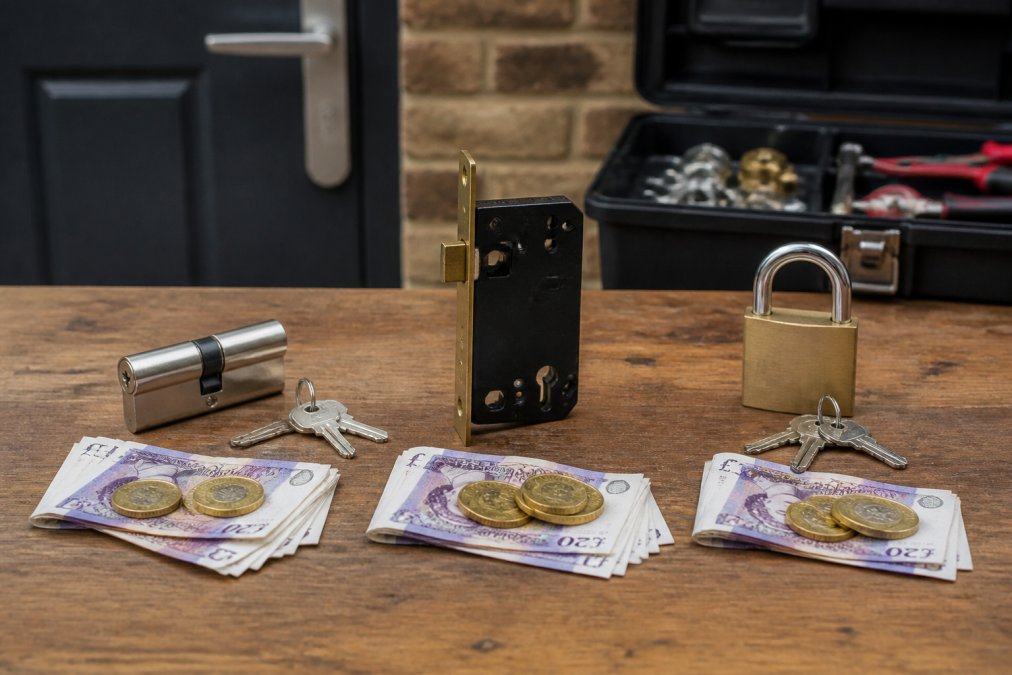
Comparing locksmith service pricing structures starts with one fact: the final bill is built from four moving parts, not a single rate. Those parts are the callout fee, the labour charge, the hardware cost, and any surcharge for timing. N&G Locksmiths Service Ltd works across Norfolk, Suffolk and Cambridgeshire, and the pattern we see is consistent: two locksmiths can quote the same job and land hundreds of pounds apart without either one lying.
Locksmith pricing is the total amount a customer pays for a visit, calculated from a callout fee, an hourly or flat labour rate, hardware costs, and time-based surcharges. Most disputes arise because one of those four elements was never stated upfront.
| Pricing Element | What It Covers | Typical Structure | Watch For |
|---|---|---|---|
| Callout fee | Travel and attendance | Fixed or waived | Whether it is per visit or per hour |
| Labour | Time on the job | Hourly or flat rate | Rounding rules and minimums |
| Hardware | Locks, cylinders, keys | Cost plus markup | Markup percentage |
| Surcharge | Timing and urgency | Percentage or fixed uplift | When the window starts |
Below, we break down each element, show where the money actually goes, and give you the exact questions that separate a transparent quote from a trap.
What Is a No Callout Fee and Why It Changes Your Final Bill
A no callout fee means the locksmith does not charge separately for travelling to you, so the price you are quoted reflects the work itself rather than the distance. That is the whole point, and it is also where most customers get caught out.
The catch, when there is one, sits in the labour rate. A business that waives the callout fee may recover it through a higher hourly rate or a longer minimum charge. Neither approach is dishonest, but only one is transparent. Ask directly: "If there is no callout fee, what is the minimum labour charge, and does the clock start when you arrive or when you set off?"
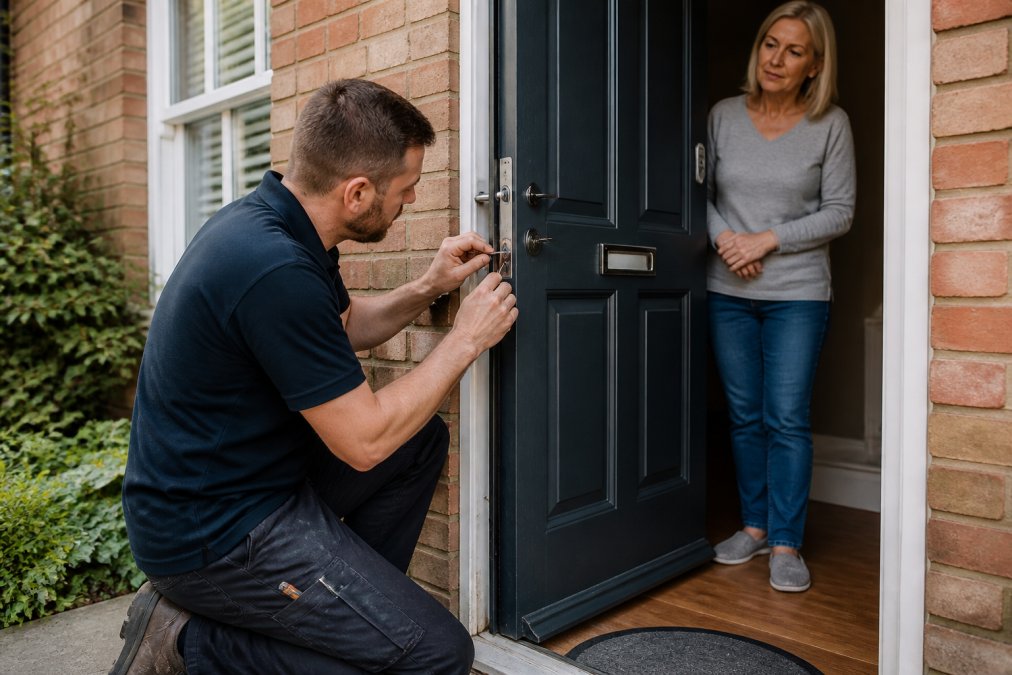
For a genuine lockout, the difference matters. A transparent provider quotes the total before dispatch, confirms it on arrival, and does not revise it upward once the door is open.
Emergency Locksmith Cost Breakdown: Where Your Money Goes
Emergency locksmith costs break down into three visible components and one invisible one. The visible parts are labour, hardware and the emergency surcharge. The invisible part is the risk premium the business carries for operating at 3am with a van stocked and a technician on standby.
Labour is usually the largest line. A straightforward lockout on a standard night latch or cylinder takes minutes to resolve, but the technician still travelled, parked, assessed the door and confirmed your identity before touching the lock. Hardware only appears if a cylinder, lock body or key needs replacing.
Here is how the money typically splits on an emergency call:
- Attendance and travel: the cost of getting a van and technician to your address, often waived by providers advertising no callout fee
- Labour: time on site, billed hourly or as a fixed price for a defined job
- Hardware: the lock, cylinder or key, plus a markup that covers stockholding and warranty
- Surcharge: the uplift applied outside standard business hours
What most guides miss is that the surcharge is not pure profit. It funds the overnight rota, the second technician on standby and the insurance that covers damage during a forced entry. A provider with no surcharge and no callout fee is either very efficient or about to make it up elsewhere.
The timing rules that decide your bill
The single biggest swing factor on an emergency call is not the lock, it is the clock. Two rules govern almost every quote, and both should be confirmed before dispatch.
When the clock starts. Some providers start billing from the moment you call; others from when the technician arrives; a few from when work begins. On a 40-minute drive that difference can add a full hour to the invoice. Ask which one applies.
The minimum charge. Most emergency providers apply a minimum attendance of one hour, even if the job takes ten minutes. This is normal and defensible, but it must be stated. A five-minute lockout billed as an hour is not a scam, it is a minimum charge, and it should have been quoted as one.
A common pattern is a three-tier structure: a standard rate during business hours, a mid-tier rate for evenings and Saturday daytime, and a full emergency rate for weekend nights and public holidays. The tiers are usually published as fixed figures rather than percentages, which makes them easy to compare between providers.
Why the emergency premium is not the same as the callout fee
These two charges are frequently confused, and the confusion is where bill shock begins.
The callout fee is a travel and attendance charge. It is fixed, it is the same at 2pm and 2am, and it is often waived entirely.
The emergency surcharge is a time-based uplift on the labour rate. It is not fixed, it scales with how far outside standard hours the job falls, and it is the line that turns a £90 daytime lockout into a £180 overnight one.
A provider can legitimately advertise "no callout fee" and still charge a substantial emergency surcharge. That is not a contradiction, but it is a distinction worth testing on the phone: "Is there a callout fee, and separately, what surcharge applies at this hour?"
The insurance angle most guides ignore
There is a second cost to an emergency call that does not appear on the invoice at all: the insurance consequence of who you let through the door.
Most home insurance policies require that locks meet a recognised standard, commonly BS 3621 for mortice deadlocks or BS EN 1303 for cylinders, and that any work affecting the security of the property is carried out competently. If an uninsured or uncertified locksmith fits a non-compliant cylinder during an emergency call, and a burglary follows, an insurer can reduce or refuse a claim on the grounds that the property was not left secure to the required standard.
That is not a hypothetical. It is the reason a slightly higher emergency quote from a certified, insured provider is often the cheaper option once the policy is factored in. Before you book, ask two questions: is the technician insured for work at your property, and will the replacement part meet the standard your policy requires? A provider who can answer both without hesitation is pricing the job honestly.
For a genuine lockout, the difference matters. A transparent provider quotes the total before dispatch, confirms it on arrival, and does not revise it upward once the door is open.
Hourly Rates vs Flat Fees: Which Pricing Model Suits Your Job?
Flat fees suit defined jobs. Hourly rates suit unpredictable ones. That single distinction resolves most of the confusion around locksmith pricing, because the right model depends entirely on whether the technician can see the finish line before starting.
A flat fee is quoted per job: "replace this cylinder, this price." You know the total before work begins, which makes budgeting simple and removes any incentive to work slowly. It is the better model for lock replacement, cylinder swaps, mortice lock fitting and upvc door repair, where the scope is visible on assessment.
An hourly rate is quoted per unit of time. It suits diagnostic work, complex commercial access systems, or a door that may need several attempts before the fault is found. The risk is obvious: without a stated maximum, an open-ended hourly rate leaves you exposed.
| Job Type | Best Pricing Model | Why | Key Question |
|---|---|---|---|
| Standard lockout | Flat fee | Scope is known and short | Is the total confirmed before dispatch? |
| Cylinder replacement | Flat fee | Defined part and labour | Is hardware included in the quote? |
| Mortice lock fitting | Flat fee | Fixed scope, known parts | Does the price cover making good? |
| Commercial access fault | Hourly | Diagnosis time varies | What is the capped maximum? |
| Multi-property rekey | Flat fee per door | Volume pricing applies | Is there a per-door rate? |
The professional certification of the technician does not change which model is fair. It changes how quickly they finish, which is exactly why a flat fee rewards you for hiring someone experienced.
After-Hours, Weekend and Emergency Surcharges Explained
After-hours surcharges are the premium charged for work outside standard business hours, typically evenings, weekends and public holidays. The size of that premium varies by provider, and it is the single most common source of bill shock.
The reason is structural. A locksmith operating at 2am on a Sunday is paying a technician a premium, running a second van on standby, and accepting a higher insurance exposure. Those costs have to sit somewhere in the price. A provider that advertises no surcharge is either absorbing that cost into a higher base rate or applying it under a different name.
Weekend rates usually sit between standard and full emergency rates. Saturday morning is often treated as near-standard, while Saturday night and all of Sunday attract the emergency premium. Bank holidays typically match the emergency rate.
- Standard business hours: base labour rate, no uplift
- Evening (typically after 6pm): modest uplift
- Weekend daytime: mid-tier uplift
- Weekend night and public holidays: full emergency rate
- Response time commitment: sometimes priced separately
This is where the "no callout fee" promise earns its keep. If attendance is genuinely free and the surcharge is stated upfront, an overnight lockout costs what you were told it would cost. If either is vague, the 2am price is whatever the technician decides at your door.
How to Verify Locksmith Credentials Before You Agree to a Price
Verifying locksmith credentials takes two minutes and should happen before you confirm a booking, not after someone is standing at your door. A legitimate provider will answer every question without hesitation.
Start with identity and insurance. Ask for the business name, a landline or traceable contact number, and confirmation of public liability insurance. A provider who will not give a business name before attending is a provider you should not book.
Then check the paperwork trail. In the UK, companies are registered at Companies House, and you can search the register free of charge via Companies House company search. A trading name that does not map to a registered company is a warning sign, not necessarily fraud, but worth a direct question.
The official guidance on avoiding rogue traders sets out the pattern clearly: pressure to decide immediately, cash-only demands, and prices that change on arrival are the recurring markers.
Ask these five questions before booking:
- What is your registered company name and number?
- Are you insured, and can you confirm the policy covers work at my property?
- Is the technician certified, and by which body?
- What is the total price, including any surcharge, before you set off?
- What guarantee applies to the work and the parts?
If you are coming from a quote that felt evasive, that instinct was probably correct. A provider who cannot answer these questions before the job is unlikely to handle a warranty claim well after it.
The Price Transparency Checklist: Questions to Ask Before Booking
Price transparency means the total cost is stated before the technician is dispatched, and it does not change unless you approve additional work. Everything else is a quote estimation exercise dressed up as a price.
Use this checklist on the phone, before you agree to anything:
- Is the callout fee included in the quoted total, or added separately?
- Is the quote a fixed price or an estimate, and what causes it to change?
- Does the price include parts, or is hardware billed on top?
- Is VAT inclusive in the figure you just gave me?
- What is the minimum labour charge, and does it apply to short jobs?
- What surcharge applies at this time of day, stated as a figure?
- Will I receive an itemised invoice showing parts and labour separately?
- What is the process if the lock fails within the guarantee period?
A provider who answers all eight without hesitation is operating a transparent pricing structure. One who deflects on three or more is not.
Insurance and warranty implications sit inside these questions. An itemised invoice is what an insurer will ask for if a claim is ever made, and a written guarantee is unenforceable if you cannot show what was agreed. Transparency protects you twice: once at the point of payment, and again if something fails later.
DIY vs Professional Locksmith Work: A Cost-Benefit Analysis
DIY lock work only pays off for a narrow set of jobs, and it costs more than it saves for the rest. The dividing line is whether a mistake leaves you locked out, with a damaged door, or with a lock that looks secure but is not.
Straightforward jobs suit a competent DIYer: replacing a standard cylinder, cutting a spare key, or swapping a night latch on a timber door. These involve few tools, reversible steps, and cheap parts if it goes wrong.
Where DIY fails is anything involving upvc door repair, multipoint locking mechanisms, mortice locks set into existing joinery, or vehicle transponder keys. These need specialist tooling and, in the case of automotive work, programming equipment that is not available to the public. A botched attempt at a multipoint mechanism can leave a door that closes but does not lock, which is worse than the fault you started with.
| Task | DIY Feasible? | Main Risk | Verdict |
|---|---|---|---|
| Cylinder replacement | Yes | Wrong size ordered | DIY saves labour |
| Spare key cutting | No | Needs key cutting machine | Professional |
| Night latch swap | Yes | Misaligned strike plate | DIY with care |
| Multipoint upvc repair | No | Door left unsecured | Professional |
| Mortice lock fitting | Rarely | Damaged door edge | Professional |
| Car key replacement | No | Immobiliser lockout | Professional |
The real cost comparison: hardware markup vs labour
The cost-benefit calculation is not just the price of the locksmith against the price of the part. It is the price of the locksmith against the part plus the cost of correcting a failed attempt, which for a damaged upvc door panel can exceed the original job.
Take the simplest case: a standard euro cylinder. Bought directly, a mid-range anti-snap cylinder costs a modest amount.
The warranty and insurance trade-off
This is the part of the DIY calculation most guides leave out, and it is often the deciding factor.
Conclusion
The gap between a fair locksmith bill and an unfair one almost never comes down to the hourly rate. It comes down to whether the callout fee, labour charge, hardware cost and surcharge were all stated before anyone set off. Ask for the total, ask what changes it, and ask for it in writing.
Frequently Asked Questions
How much is the average locksmith charge?
Locksmith charges vary based on the service, time of day, and location. A standard lockout during business hours will cost less than an emergency call at 2 AM. Factors include the callout fee, labour rate, and any parts needed. N&G Locksmiths Service Ltd offers transparent locksmith pricing with no callout fee, so you only pay for the work done. Always request a quote before agreeing to any work.
How do locksmiths calculate labour costs for emergency work?
Locksmiths typically calculate emergency labour costs by applying a higher hourly rate or a fixed emergency fee outside standard business hours. This covers the inconvenience of unsociable hours and the immediate dispatch of a technician. Some companies charge a premium on the total job, while others add a separate after-hours surcharge. Ask for a full emergency locksmith cost breakdown before the technician arrives.
How do I avoid being overcharged by an emergency locksmith?
To avoid overcharging, verify the locksmith's credentials and ask for a written quote before work begins. Check for a fixed price or clear hourly rate, and confirm whether VAT is inclusive. Reputable locksmiths like N&G Locksmiths Service Ltd provide upfront pricing. Avoid paying cash without an invoice, and never agree to work without a clear price.
What factors influence the final price of a locksmith service?
The final price depends on the type of lock, time of service, location, and whether replacement parts are needed. Emergency callouts, after-hours surcharges, and travel time can increase costs. Hardware costs vary by lock brand and security rating. A no callout fee structure removes one common charge. Always ask for a detailed quote that separates labour from parts.
Are there standard pricing structures for locksmith services?
There is no single standard, but most locksmiths use one of three models: hourly rate plus parts, flat fee per job, or a callout fee plus labour. Some offer no callout fee and charge a higher hourly rate instead. Understanding these locksmith pricing structures helps you compare quotes fairly. Request a breakdown of labour, hardware, and any surcharges before booking.