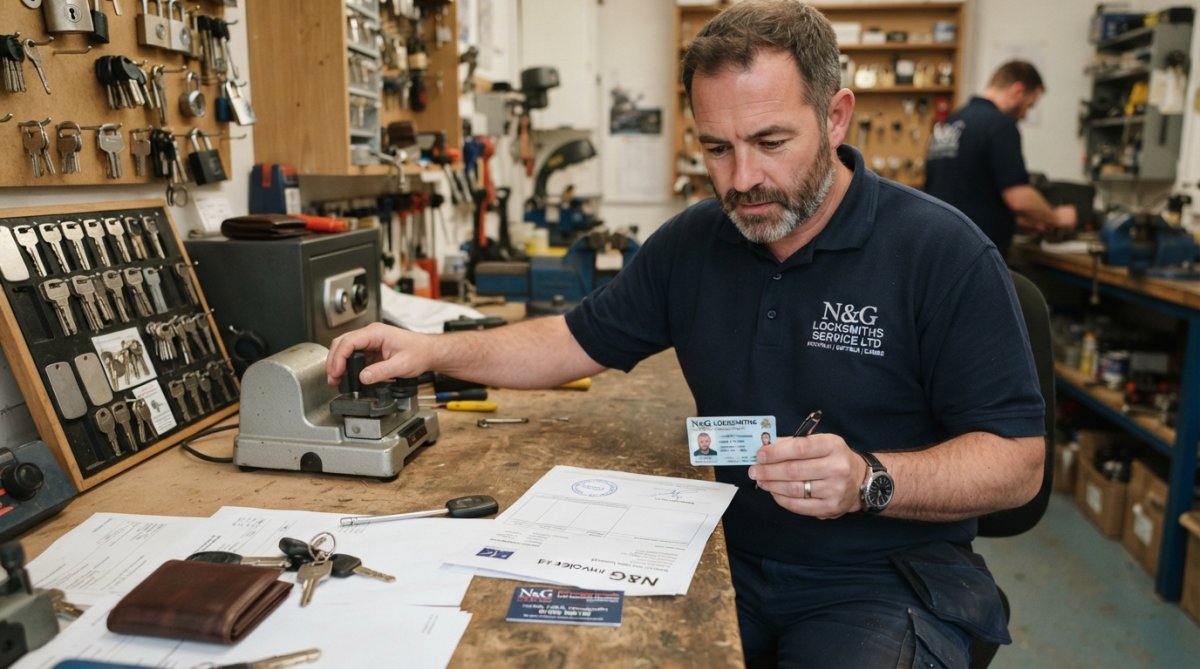
 how-to
How to Verify Local Locksmith Legitimacy: 2026 Guide
Table of Contents
- Why Verifying a Locksmith Before You Call Matters
- How to Spot a Rogue Locksmith: Red Flags to Watch For
- Check for Master Locksmiths Association Approved Status
- Verify Credentials, Licensing, and Public Liability Insurance
- Digital Footprint Verification: Checking Address, Registration, and Reviews
- Emergency Locksmith Pricing Transparency: Questions to Ask Before You Agree
- Identity Verification on Arrival and Post-Service Checks
- Conclusion: Building Confidence in Your Local Locksmith
- Frequently Asked Questions
Last Updated: September 13, 2026
Why Verifying a Locksmith Before You Call Matters
Learning how to verify local locksmith legitimacy before you hand over your keys is one of the most important security decisions a homeowner can make. A rogue locksmith can overcharge you, damage your door, or leave you with substandard hardware that fails when you need it most. This guide from N&G Locksmiths Service Ltd walks through the exact checks that separate a genuine professional from a fraudster. The stakes are higher than most people realise: a scammer who gains entry to your property has access to everything inside it.
The problem is that a real emergency leaves no time for careful research. You are standing outside your home at midnight, or stranded beside your car in the rain. That pressure is precisely what rogue traders exploit.
Below, we break down the verification steps you can take in under five minutes, plus the deeper due diligence worth doing before any non-urgent job.
How to Spot a Rogue Locksmith: Red Flags to Watch For
The clearest sign of a rogue locksmith is a refusal to give a price before arriving. Legitimate locksmiths quote a call-out fee and an hourly or fixed rate over the phone, then confirm it in writing. A trader who says "we'll discuss it when we get there" is setting up an inflated invoice.
Other warning signs include:
- No company name on the vehicle, or a plain white van with no sign writing
- A mobile number only, with no landline or business listing
- Pressure to pay cash immediately, before you have inspected the work
- Insistence on drilling and replacing the entire lock when a simple pick would do
- No written estimate, invoice, or receipt offered
A common mistake is assuming a smart uniform equals legitimacy. Anyone can buy a branded polo shirt. The paperwork matters far more than the appearance.
Check for Master Locksmiths Association Approved Status
The single fastest credibility check is membership of the Master Locksmiths Association (MLA), the trade body that vets and inspects locksmith businesses. MLA approved status means the company has passed a criminal record check, demonstrated competence, and agreed to a code of practice. You can confirm membership by searching the MLA's own directory rather than trusting a logo on a website.
Ask for the company's MLA registration number and verify it independently. A genuine member will give it without hesitation.
Not every competent locksmith belongs to a trade association, so absence of MLA status is not proof of dishonesty. But the reverse is true: a claimed membership that does not check out is a serious red flag. Cross-reference any claim against the Master Locksmiths Association member directory before you commit.
Verify Credentials, Licensing, and Public Liability Insurance
A legitimate locksmith should be able to produce three things on request: proof of identification, evidence of relevant training or certification, and a current insurance certificate. Most guides stop at the word "insurance" and never tell you what to actually ask for. This section does.
The two policies a locksmith should hold
There is no single government-issued locksmith licence in the UK, so insurance and trade-body vetting carry most of the credibility weight (gov.uk). A professional operator will typically hold:
- Public liability insurance, covers injury to a person or damage to third-party property (your door, frame, glazing, or a neighbour's vehicle) arising from the work. Cover of £1 million is a common minimum; many established firms carry £2 million or £5 million.
- Professional indemnity / treatment risk cover, covers claims that the work itself was faulty, such as a lock that fails shortly after fitting or a key cut to the wrong profile.
Some policies bundle both. Ask which applies to your job, because a public liability policy alone will not always respond to a workmanship complaint.
How to check a locksmith's insurance policy
Ask the locksmith to email the certificate before work begins, a genuine firm will send it without hesitation. What you are looking for is a Certificate of Insurance (sometimes called a Certificate of Currency) issued by the insurer or broker, not a screenshot of a marketing badge. Check four things:
- Policy period, the cover must be in force on the date of your job, not expired last month.
- Named insured, the business name on the certificate must match the company you are hiring and the name on your quote. A certificate belonging to a different firm, a franchise head office, or an individual trading under another name is worthless to you.
- Cover type and limit, confirm it is public liability (and professional indemnity if relevant) and note the limit. A £1 million limit is a floor, not a benchmark.
- Business description, the policy should describe the insured activity in terms that cover locksmithing, not unrelated trades.
If you have time, call the broker or insurer named on the certificate and quote the policy number to confirm it is active. This is the step most customers skip, and it is exactly where fraudulent operators get caught out, a cancelled or lapsed policy looks identical to a live one on a PDF.
Training and certification to look for
Beyond insurance, ask what training the technician holds. Recognised signals include:
- MLA Approved Company status (the company, not just the individual)
- City & Guilds or equivalent locksmithing qualifications
- Manufacturer training for the specific lock brand being fitted (for example, a certified installer for a high-security cylinder range)
- A current DBS (Disclosure and Barring Service) check, which MLA-approved firms require of staff (gov.uk)
None of these is a legal requirement, but a locksmith who can name their qualifications and produce evidence of them is behaving like a professional. One who cannot, and who resists the question, is not.
Digital Footprint Verification: Checking Address, Registration, and Reviews
A genuine local business leaves a consistent trail across the internet. Before you call, spend two minutes checking that the company's website, Google Business Profile, and Companies House record all tell the same story. Rogue operators frequently use virtual addresses or list a location they have no real presence at.
Confirming a Physical Business Address
Search the business name on Companies House, the official register of company incorporations. A registered company will appear with a company number, incorporation date, and registered office. If a locksmith claims to be an established local firm but has no Companies House record at all, treat that as a warning.
Then check the address itself on a map. A real locksmith business typically has a workshop, a unit, or a premises where vans are based. A residential terraced house listed as the "head office" of a company claiming dozens of engineers is unlikely to be genuine.
Reviews deserve the same scrutiny. Look for a steady history of reviews over months or years, with specific detail about the job done. A burst of five-star reviews posted within the same week is a classic sign of fabricated feedback.
| Check | What to Look For | Red Flag |
|---|---|---|
| Companies House | Active registration, real address | No record, or dissolved status |
| Website | Physical address, landline number | Mobile only, vague location |
| Reviews | Consistent history, specific detail | Sudden burst of generic praise |
| Trade body | Verifiable MLA membership | Claimed but unverifiable |
Emergency Locksmith Pricing Transparency: Questions to Ask Before You Agree
Emergency locksmith pricing transparency comes down to one rule: get the full cost confirmed before the locksmith sets off. Ask directly what the call-out fee is, what the hourly rate covers, and whether parts are included or charged separately. A trustworthy operator answers these questions plainly.
Questions worth asking on the phone:
- What is your total call-out fee, including travel?
- Is there a surcharge for out-of-hours or weekend work?
- How much do replacement locks cost, and are they included in the quote?
- Will I receive a written estimate before you start?
- What is your policy if the lock cannot be opened without damage?
If the answers keep shifting, or the person on the line dodges the pricing question, call someone else. N&G Locksmiths Service Ltd charges no call-out fee, so you know the cost before anyone arrives.
What to Do If You Suspect a Scam
If a locksmith demands a price far above the quote, refuses to leave, or pressures you for immediate cash, do not pay under duress. Ask for a written invoice and a breakdown of charges. If you feel unsafe or intimidated, call the police on 999. For non-urgent disputes, report the trader to Citizens Advice consumer service, which passes cases to Trading Standards. Keep every text, email, and receipt as evidence.
Identity Verification on Arrival and Post-Service Checks
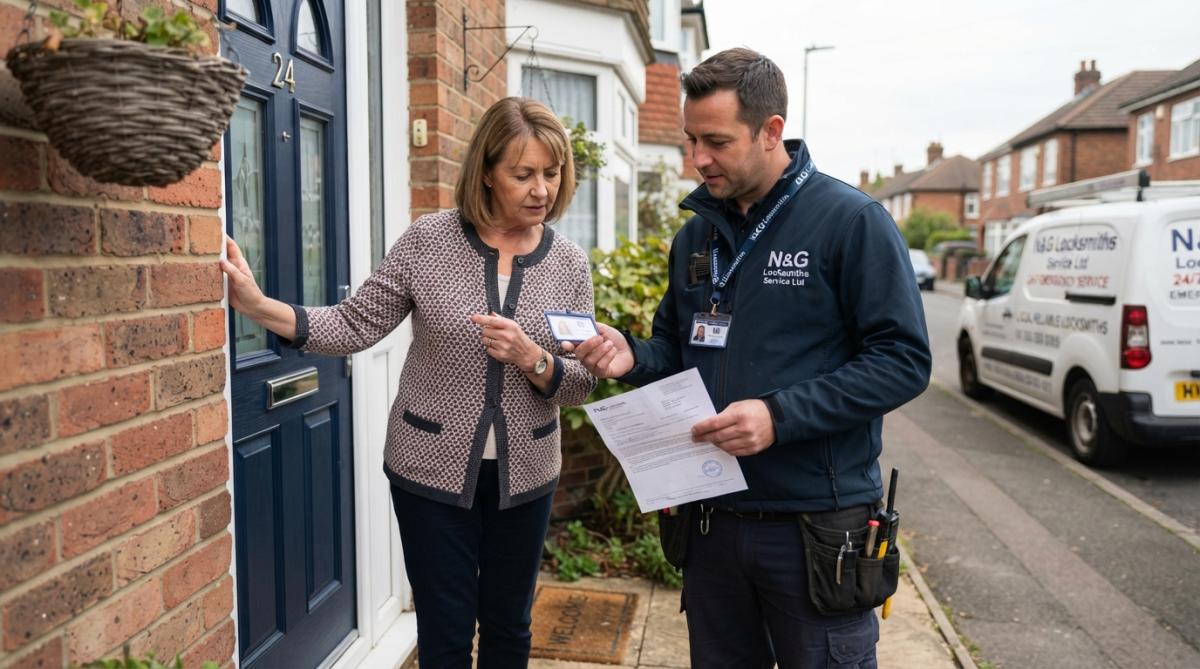
Identity verification on arrival is the final gate before you let anyone into your home. When the locksmith arrives, ask to see photo ID and confirm the name matches the company you booked. A genuine technician expects this and will not be offended. If the person who turns up is not the person you spoke to, or cannot name the company they work for, do not let them start.
What to check before work begins
- Photo ID (driving licence or passport) matching the name on your booking
- The company name on the van, uniform, or paperwork matching your quote
- A written quote or job sheet stating the price before any drilling starts
- Confirmation that the price still stands, no "it's worse than we thought" surcharge before the lock is even touched
Post-service verification: what to check after the job is done
This is the part almost every guide omits, and it is where you protect yourself if something goes wrong weeks later. Once the work is complete, run through the following before the locksmith leaves:
- Written invoice showing the company's full legal name, trading address, and, if they are VAT-registered, a valid VAT number. A VAT-registered business must issue a VAT invoice; if they claim to be VAT-registered but the number does not appear, that is a discrepancy worth noting.
- Itemised breakdown of labour, call-out, and parts, so the total matches the quote you agreed.
- Guarantee or warranty document in writing stating what is covered, how long it lasts, and how to make a claim. A verbal "it's guaranteed" is not a guarantee.
- Manufacturer warranty details for any new lock or cylinder fitted, including the product name and any registration the installer completed on your behalf.
- Test every lock yourself, lock and unlock each one, including from the outside, before the locksmith leaves.
- Note the technician's name and vehicle registration for your records.
- Keep the receipt, invoice, and warranty documents somewhere you can find them if you need to claim.
Paying in a way that protects you
Pay by card or bank transfer wherever possible. Both create a traceable record and, for card payments over £100, may give you a route to a chargeback or Section 75 claim against the card issuer if the work is faulty or the trader disappears. Cash leaves you with almost no recourse. Never pay the full amount before the work is finished and you have inspected it.
N&G Locksmiths Service Ltd backs its workmanship with a 12-month guarantee, so any fault traced back to the fitting is covered. That written commitment is what separates a professional from a trader who vanishes the moment they are paid.
Conclusion: Building Confidence in Your Local Locksmith
Verifying a locksmith takes minutes, but the consequences of skipping it can last far longer. A few quick checks against official registers, a request for insurance paperwork, and a clear price agreed upfront will filter out almost every rogue operator before they reach your door. For genuine emergency cover across the region, N&G Locksmiths Service Ltd offers 24/7 response, no call-out fee, and a 30-minute response time, backed by a 12-month guarantee and fully insured, certified professionals. Get started with N&G Locksmiths Service Ltd.
Frequently Asked Questions
How do I know if a locksmith is legitimate?
Check for Master Locksmiths Association approval, verify public liability insurance, and confirm a physical business address and Companies House registration. Ask for a written quote before work starts, check the technician's ID on arrival, and look for genuine reviews on independent platforms. A legitimate locksmith will provide all of this without hesitation and will never pressure you into paying cash without an invoice.
Do locksmiths have to be registered in the UK?
Locksmiths are not legally required to be registered in the UK, so there is no government licensing scheme. However, voluntary trade association membership, such as Master Locksmiths Association approval, signals that a locksmith has met background checks and professional standards. Always ask about trade association membership and DBS checks, and verify these directly with the association rather than relying on a logo on a website.
What are the common red flags of a rogue locksmith?
Watch for no physical business address, refusal to give an upfront quote, cash-only payment demands, unmarked vehicles, no ID on arrival, and prices that change dramatically once the lock is drilled. A rogue locksmith may also answer with a generic call centre name, use high-pressure tactics, and fail to provide a service invoice or written estimate. If any of these appear, stop and call a verified local locksmith instead.
Should I ask for identification from a locksmith on arrival?
Yes, always ask for photo ID and confirm it matches the name on your booking and the company's records. A legitimate locksmith will carry a company ID badge and a sign-written vehicle. You can also call the company's published number to confirm the technician dispatched to your address. This identity verification step protects you from unauthorised individuals posing as locksmiths and ensures you are dealing with the business you actually contacted.