 listicle
Best Lock Brands for Security: A 2026 Comparison
Table of Contents
- Quick Comparison: Best Lock Brands for Security
- How We Evaluated These Lock Brands
- 1. Yale: Smart Convenience Meets Everyday Security
- 2. Mul-T-Lock: Patented Key Control for High-Security Doors
- 3. Schlage: Mechanical Deadbolts Built to Last
- 4. Medeco: Heavy-Duty Protection Against Sophisticated Attack
- 5. August: Retrofit Smart Locks for Renters and Homeowners
- 6. Eufy Security: Biometric Entry Without Subscription Fees
- 7. Aqara: Smart Home Integration for Automation Enthusiasts
- 8. Lockly: Anti-Theft Keypad Technology for Peace of Mind
- Which Lock Brand Is Right for Your Door?
- Frequently Asked Questions
Last Updated: September 22, 2026
Quick Comparison: Best Lock Brands for Security
Choosing among the best lock brands for security comes down to matching the lock to how your door is actually used. A high-security cylinder protects against drilling and snapping, while a smart lock adds convenience and remote access. Most homes need one of each.
This guide compares eight lock brands on physical resistance, smart features, and value, so you can choose with confidence.
| Brand | Best For | Starting Price | Standout Feature |
|---|---|---|---|
| Yale | Smart convenience | £150 | App control and auto-lock |
| Mul-T-Lock | High-security doors | £100 | Patented key control |
| Schlage | Mechanical deadbolts | £80 | Grade 1 durability |
| Medeco | Heavy-duty protection | £120 | Hardened steel inserts |
| August | Renters | £180 | Retrofit design |
| Eufy Security | Biometric entry | £130 | Fingerprint access |
| Aqara | Smart home users | £140 | HomeKit integration |
| Lockly | Keypad security | £190 | PIN Genie keypad |
How We Evaluated These Lock Brands
We judged each brand on four things: physical security, smart features, ease of fitting, and long-term reliability. Physical security carries the most weight, because a lock that fails a snap or drill attack offers no protection regardless of how polished its app is.
Rather than repeat marketing claims, we looked at how each lock is actually tested and what it has to survive to earn a recognised rating. That is the only way to compare a £60 cylinder against a £200 one honestly.
The standards that matter
BS 3621 is the benchmark for thief-resistant mortice deadlocks. To meet it, a lock must resist a defined set of attacks for a minimum period, including drilling, picking, and force applied to the bolt. Many home insurers in the UK require a BS 3621 lock on the final exit door as a condition of cover, so this is not an abstract badge, it can affect whether a claim is paid.
BS EN 1303 grades cylinders on a scale from 1 to 6 for key security and attack resistance. A high grade means the cylinder resists drilling, picking, and key manipulation for longer under test.
TS 007 is the anti-snap standard for cylinders. It runs from 1 to 3 stars. A 3-star cylinder is tested to resist snapping, drilling, and picking, and it is the rating insurers most often look for on a euro cylinder. Where a door uses a 1-star cylinder, it must be paired with a 2-star handle or security escutcheon to reach the equivalent 3-star protection.
Secured by Design is the police-backed scheme that certifies products meeting defined security standards. A lock carrying the Secured by Design mark has been independently tested rather than self-declared.
How locks are actually attacked
Understanding the attack tells you what the rating is protecting against.
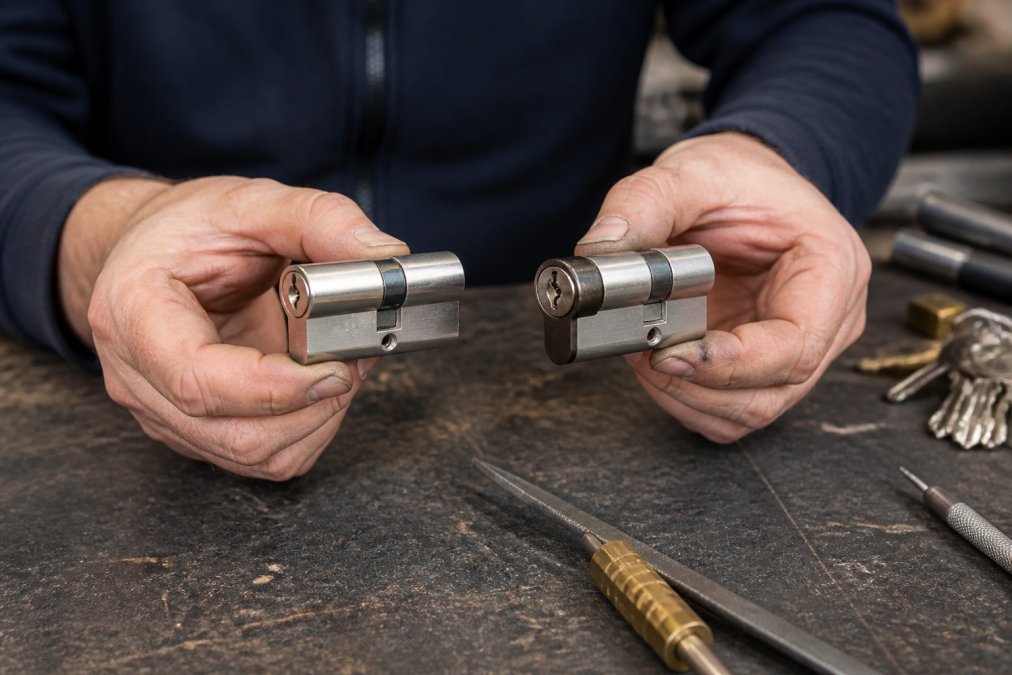
- Snapping. The attacker grips the protruding cylinder with a tool and snaps it at the weakest point, exposing the lock mechanism. This is why cylinder length matters, a cylinder that protrudes more than about 3mm beyond the door face is far easier to snap. Anti-snap cylinders are designed to break at a sacrificial point that leaves the mechanism intact.
- Drilling. A hardened drill bit is driven into the cylinder or the lock case to destroy the pins or the bolt. Anti-drill plates and hardened steel inserts slow this down, and the better cylinders use rotating hardened pins that spin the drill bit off course.
- Picking and bumping. Picking manipulates the pins directly. Bumping uses a specially cut key struck while inserted to jolt the pins into position. Patented keyways and security pins make both far harder.
- Force attacks. Crowbars, chisels, and kick attacks target the door, frame, and hinges as much as the lock. A premium cylinder in a weak frame still fails, which is why we weigh the whole assembly.
What we checked on each brand
For every brand below we looked at whether the product carries a recognised rating (BS 3621, TS 007, BS EN 1303, or Secured by Design), how the mechanism resists snap, drill, and pick attacks, whether key control is restricted, and, for smart locks, how it behaves when the battery dies or the network drops. We also weighed battery life and maintenance frequency, since a lock that needs constant attention is a lock that gets left unlocked.
Secured by Design approved products search
1. Yale: Smart Convenience Meets Everyday Security
Yale blends established brand trust with genuinely useful smart features. The Yale smart lock range offers remote access through a mobile app, auto-lock based on proximity, and compatibility with Alexa and Google Assistant.
For a household that wants keyless entry without a steep learning curve, Yale is a strong starting point. The app is clear, and the ecosystem is well supported.
- Pros: Wide service network, user-friendly app, voice assistant support
- Cons: Smart features need regular battery maintenance
If you want a familiar name and reliable smart integration, Yale delivers. Just budget for batteries and keep a key override accessible.
2. Mul-T-Lock: Patented Key Control for High-Security Doors
Mul-T-Lock specialises in high-security cylinders with patented key control. Its telescopic pin tumbler mechanism resists drilling and picking, and key duplication is restricted to authorised centres.
That restriction matters. It stops a lost key from being copied by anyone who finds it. For a property that needs tight control over who holds keys, this is a serious advantage.
The trade-off is convenience. If you lose a key, you must go through an authorised centre to replace it. For landlords managing multiple properties, that control is usually worth the friction.
3. Schlage: Mechanical Deadbolts Built to Last
Schlage earns its place through mechanical durability. Its deadbolts carry Grade 1 certification for impact resistance, and the cylinder technology resists picking and drilling.
This is the brand to choose when you want a lock that simply works, year after year, without an app or a battery. For a front door that sees heavy daily use, a solid mechanical deadbolt is hard to beat.
- Pros: Highly durable, respected by professional locksmiths
- Cons: Higher price than entry-level consumer brands
Pair a Schlage deadbolt with a quality anti-snap cylinder and you have a front door that stands up to real attack.
4. Medeco: Heavy-Duty Protection Against Sophisticated Attack
Medeco builds locks for high-risk environments. Its keys use angled cuts that are extremely difficult to copy, and hardened steel inserts resist drilling.
The brand is UL 437 listed for drill and pick resistance, a standard that few consumer locks meet. That makes Medeco a sensible choice for commercial premises or homes in higher-risk areas.
The premium pricing reflects the engineering. If your threat model includes a determined intruder rather than an opportunist, the extra cost is justified.
5. August: Retrofit Smart Locks for Renters and Homeowners
August solves a specific problem: adding smart entry without replacing the whole lock. Its retrofit design keeps your existing keys and fits over the current deadbolt.
DoorSense technology monitors whether the door is closed and locked, and the activity log tracks entries and exits. For renters who cannot change the lock outright, this is the practical route to keyless entry.
- Pros: Easy installation, keeps existing keys, maintains exterior look
- Cons: Performance depends on the quality of your existing deadbolt
6. Eufy Security: Biometric Entry Without Subscription Fees
Eufy Security offers fingerprint recognition for fast access and built-in Wi-Fi for remote control, with no monthly subscription for basic features. The weatherproof construction suits exposed doors.
Biometric entry is genuinely convenient. You arrive, touch the sensor, and the door opens. No keys, no codes to remember.
The catch is connectivity. Remote features depend on a stable Wi-Fi signal. If your router drops, you fall back to the keypad or key override.
7. Aqara: Smart Home Integration for Automation Enthusiasts
Aqara suits homes already built around a smart ecosystem. Its locks support Apple HomeKit and other platforms, offer multiple entry methods, and send tamper alerts.
If you run automations, Aqara fits neatly in. The lock can trigger lights, cameras, or heating as you arrive.
- Pros: Seamless smart home integration, minimalist design
- Cons: May need a hub for full functionality
For an automation-first household, Aqara is the natural pick. For everyone else, it adds complexity you may not need.
8. Lockly: Anti-Theft Keypad Technology for Peace of Mind
Lockly is best known for its PIN Genie keypad, which shuffles the number positions each time, defeating shoulder surfing. It pairs this with a 3D biometric fingerprint sensor and offline access codes for guests.
The anti-theft keypad is a clever answer to a real problem. Someone watching you enter a code cannot learn the pattern.
The main drawback is size. The lock has a larger footprint on the door, which may not suit a slim or period door.
Which Lock Brand Is Right for Your Door?
The right choice depends on your door, your tenancy or ownership, and what your insurer expects. Work through these in order.
1. Check what your insurer requires
Most home insurance policies in the UK set out a minimum standard for the final exit door. The common requirement is a BS 3621 mortice deadlock or a TS 007 3-star cylinder, sometimes with a five-lever mortice lock on wooden doors. If your policy names a standard and your lock does not meet it, a burglary claim can be reduced or refused. Check your policy schedule before you buy, it is the single most common reason a lock upgrade is rejected after the fact.
2. Match the lock to the door
- uPVC or composite doors almost always use a euro cylinder. This is where anti-snap matters most, because the cylinder protrudes and is the easiest point of attack. A TS 007 3-star cylinder is the priority here.
- Timber doors typically take a mortice lock. A BS 3621 five-lever mortice deadlock is the standard, and it can be paired with a nightlatch for convenience.
- Period or listed doors may not accept a large smart lock body. Slimline cylinders and surface-mounted options preserve the look without weakening the door.
3. Decide between mechanical and smart
If your priority is insurance compliance and resistance to physical attack, a mechanical high-security cylinder (Mul-T-Lock, Medeco) paired with a BS 3621 mortice lock is the strongest combination. If your priority is convenience, a smart lock (Yale, Aqara, Lockly) adds keyless entry, but check that the smart lock's cylinder still carries the rating your insurer wants. Many smart locks ship with a standard cylinder that does not meet TS 007, so the physical security can be weaker than the lock it replaced.
4. If you rent, work with what you have
Renters usually cannot replace the landlord's lock, and drilling new hardware is a breach of most tenancy agreements. The non-destructive options are:
- Retrofit smart locks (August-style) that fit over the existing deadbolt and keep the original keys, so the lock can be removed at the end of the tenancy.
- A portable door lock or travel lock for additional security on the inside of the door, which requires no tools and leaves no marks.
- A door chain or limiter fitted with the landlord's written permission, these are cheap, reversible, and deter the most common distraction-burglary tactics.
- A window and door alarm that sticks or screws into the frame, adding an audible deterrent without altering the door itself.
If you are a tenant, ask the landlord in writing before any change. A lock upgrade that meets BS 3621 or TS 007 is usually welcomed, because it protects the landlord's asset too, but get the permission on record.
5. Budget for fitting, not just the lock
A poorly fitted lock leaves gaps an intruder can exploit, and a cylinder that protrudes too far is easy to snap. Professional fitting matters as much as the brand. When comparing quotes, ask whether the price includes the cylinder, the handles or escutcheons needed to reach the rating, and any making good to the door.
Whichever brand you choose, the goal is the same: a lock that meets the standard your insurer requires, resists the attacks that are actually used, and suits how you use the door every day.
Frequently Asked Questions
What is the best lock for security?
The most secure option combines a British Standard BS3621 mortice lock or a TS007 3-star anti-snap cylinder with a solid door and reinforced strike plate. Look for SS312 Diamond or TS007 3-star ratings, which test resistance to snapping, drilling, picking and bumping. Brands like Mul-T-Lock and Medeco lead on physical attack resistance, while Yale and Eufy offer strong smart features. The right choice depends on your door type, insurance requirements and whether you need keyless entry.
Which brand door lock is best?
There is no single best brand because door type, insurance rules and budget all affect the answer. Mul-T-Lock and Medeco suit high-risk properties needing patented key control and drill resistance. Yale and Schlage balance mechanical strength with smart features. August and Aqara work well for renters or smart home users. Check that your chosen lock meets your insurer's minimum standard, usually BS3621 for mortice locks or TS007 3-star for cylinders.
Which door locks are the most secure?
Locks rated to BS3621, SS312 Diamond or TS007 3-star offer the highest resistance to common attack methods including snapping, drilling, picking and bumping. A deadlocking mortice lock fitted with a reinforced strike plate and a solid hardwood or composite door provides the strongest setup. Smart locks add convenience but should still carry a physical security rating. If your cylinder protrudes more than 3mm from the door face, it is vulnerable to snapping regardless of brand.
Are British Standard locks the most secure?
British Standard BS3621 locks meet a rigorous set of tests for resistance to drilling, picking, force and manipulation, and most home insurers require them on external doors. However, BS3621 applies to mortice locks and some rim locks, not to euro cylinder locks. For cylinders, look for TS007 3-star or SS312 Diamond ratings instead. Combining a BS3621 mortice lock with a 3-star anti-snap cylinder gives you the strongest insurance-approved setup.